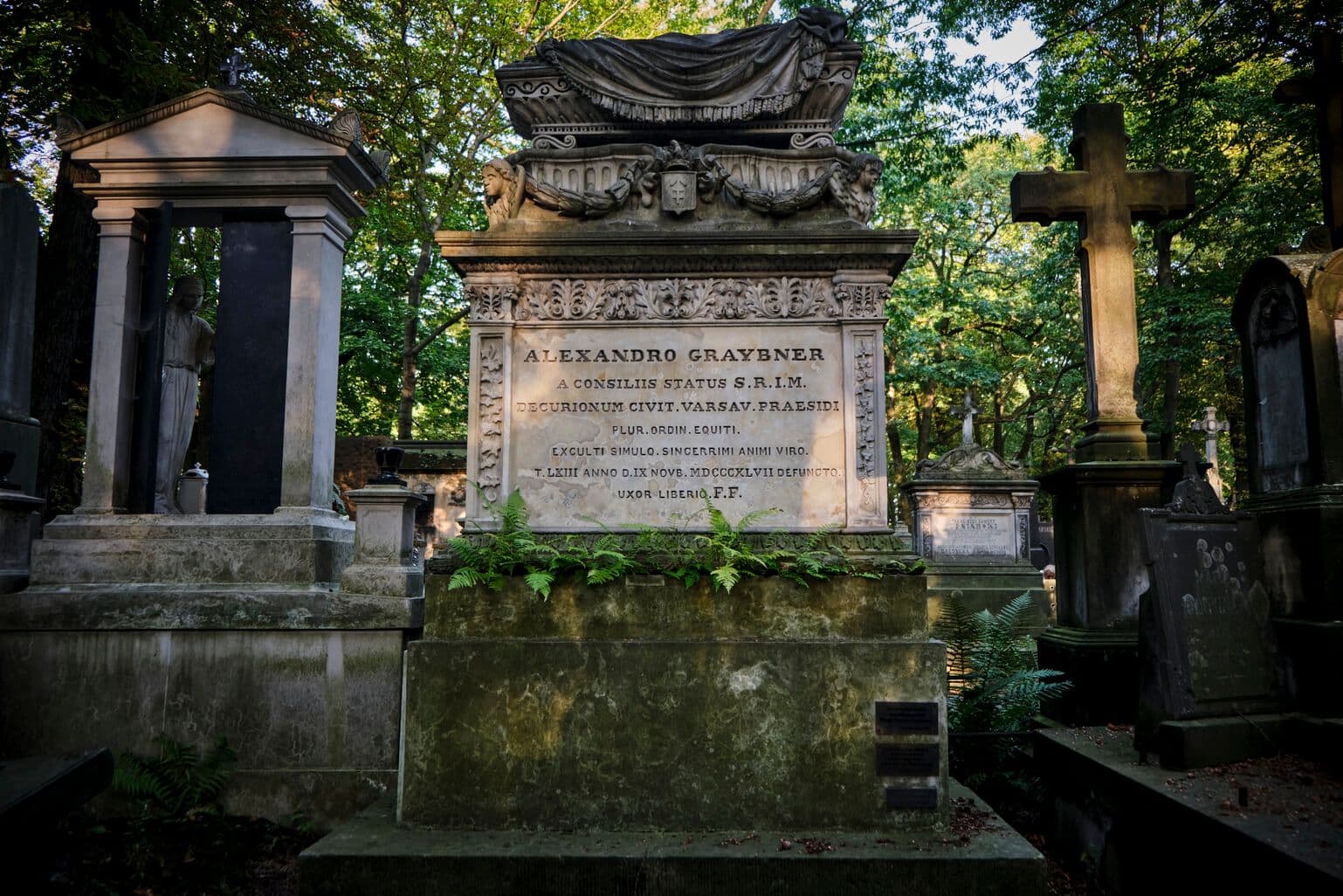

Aleksander Józef Graybner of the Fox coat of arms (1786–1847)
In the "History of Warsaw" published in the 1970s, there is not even a mention of Aleksander Graybner. We will not find him even in the 1975 Encyclopedia of Warsaw. Apparently, Novosiltsev, with whom he knew how to get along, and the numerous Russian orders he received, were enough to erase all his achievements in the eyes of the censors. In addition, one of his daughters probably married someone from a family of Russian origin—judging by the surname, though this may be misleading. Her husband, whom she married in 1833 at St. Alexander's Church in Warsaw, was named Piotr Popow. He was the son of Jan and his wife Wasilisa, neé Somow. After the November Uprising, such marriages were not looked upon kindly. Graybner is appreciated in Kock, where he was born and where one of the streets bears his name.
It is a great shame that so little is said about his work in Warsaw, as he was one of the city's most distinguished presidents. Only the reliable and fair-minded Szenic devoted considerable space to him, and it is from him that we learn that this son of Stanisław August Poniatowski's chamberlain was one of the best-educated presidents to have served in Warsaw. He first studied at a humanities gymnasium in Kraków, where he also studied law at the Jagiellonian University. He completed his studies in physics and higher and applied mathematics at Vilnius University.
His contributions to the city are hard to overestimate. The most important were the introduction of a ban on wooden buildings, the paving of dozens of streets and the laying of sidewalks, as well as attention to transport and trade. During his presidency, the Gościnny Dwór was built—a vast market hall that no modern city would be ashamed to have. It housed 168 shops and just as many market stalls. The Pancer Viaduct, which for many years made it easier to cross the Vistula, was also a result of his administration. Significantly, in 1837 Powązki came under municipal administration, and the cemetery supervisor approved by the president was Ignacy Szulc, a true godsend who put the cemetery in order over the 40 years he worked there. After the president's death, his wife, Aniela née Stanisławska, funded his tombstone. She chose a popular, Classical style of tombstone, copied directly from a French pattern book by Joseph Marty, as discovered by Dr. Marta Wiraszka of the Institute of Art History at Cardinal Stefan Wyszyński University in Warsaw.