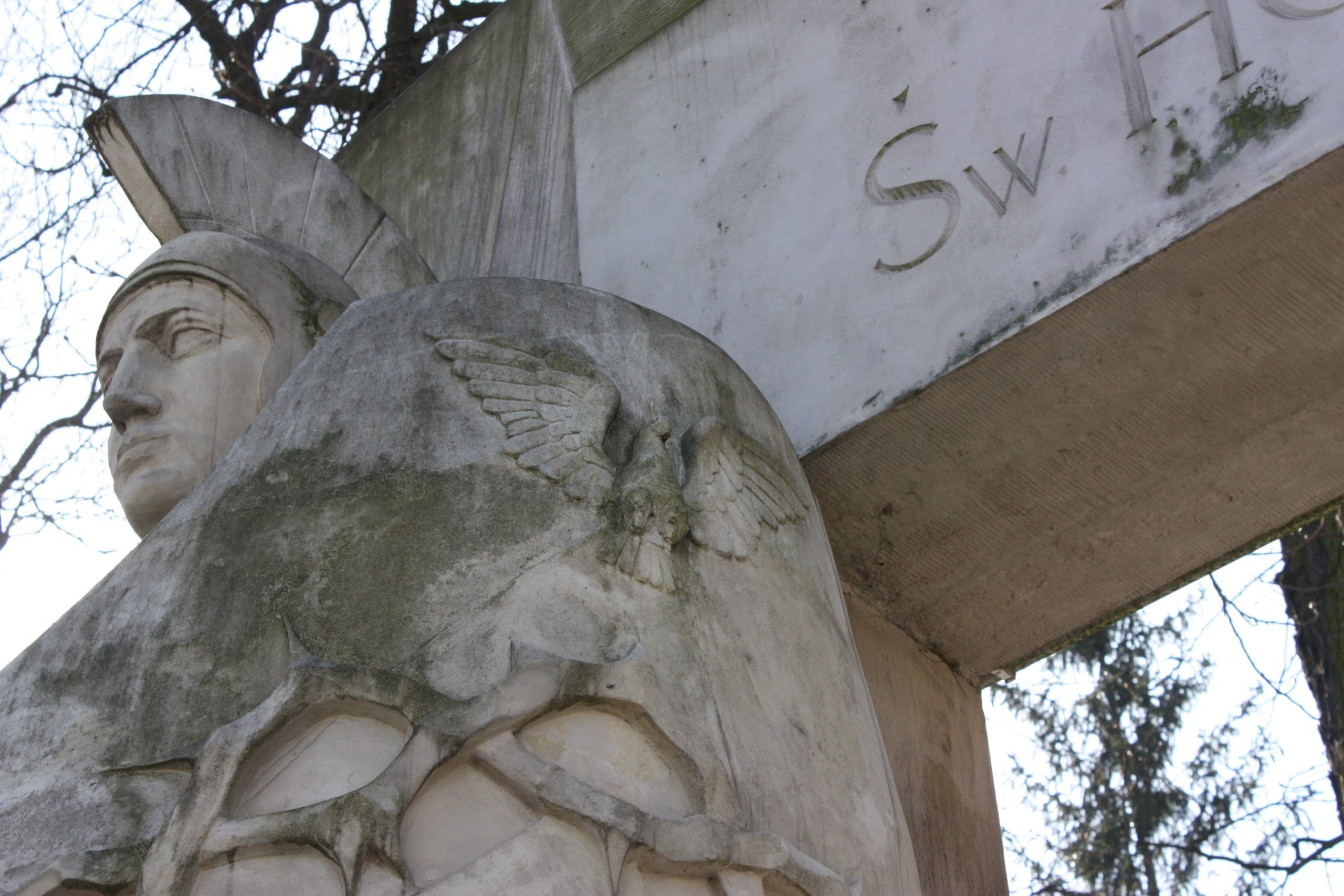

A memorial to his deceased wife
Old Powązki Cemetery is a place where loved ones have commemorated their dead; the Gate of Saint Honorata is one such example.
The wicket is located near the church, and not everyone entering the cemetery realizes that this ceremonial gate, along with its impressive sculpture and architectural setting, was created to commemorate a loved one. That person was Honorata Landsberg.
When Honorata died on January 25, 1915, her husband, Mieczysław Landsberg, decided to commemorate her not with a magnificent tomb, but with the monumental setting of the second gate of Powązki Cemetery. Thanks to his decision, today, as we enter Warsaw's oldest necropolis, we can pass through a symbolic wicket featuring a huge figure of a divine warrior, styled as a Roman legionary. Mieczysław Landsberg was Honorata's second husband. Her maiden name was Zwolińska, while after her first marriage she was known by the surname Jeziorowska. Mieczysław Landsberg was a respected doctor in Warsaw, practicing in the late 19th and early 20th centuries. He was born in the 1860s. For a time, he practiced in Moscow, eventually moving to Warsaw. He was renowned for helping the city's poorest residents free of charge.
He and his wife Honorata had no children (Honorata had a son from her first marriage). Mieczysław was a wealthy man; as a good doctor, he was respected and appreciated, so he was not short of money. His grief after his wife's death was profound, and he decided to honor her in a spectacular way. He offered to fund the architectural setting of the Powązki Cemetery gate. The gate was to be made according to a drawing by Dr. Landsberg himself. Dr. Landsberg was evidently determined and acted swiftly: he made his offer in March, and the impressive wicket was unveiled as early as June. The pace was truly astonishing, especially as this was during the raging First World War. Fierce fighting was taking place on a front not far from Warsaw, and the city was subject to the chaos of a town near the front.
Leopold Wasilkowski created the gate and incorporated it into the entrance, producing a modernist work "of a synthetic, somewhat geometricized form," as Maria Irena Kwiatkowska wrote about the Gate of Saint Honorata.
The grief-stricken Mieczysław Landsberg outlived his wife by only a year and a half. He died in July 1916 and was laid to rest in the catacombs, like his wife.
Thanks to the gift of Dr. Mieczysław Landsberg, a larger-than-life figure of a divine knight now stands in the cemetery gate, leaning on a sword that pierces a dead snake, symbolizing the defeat of evil. The warrior's shield bears the Eye of Providence within a crown of thorns, along with three nails symbolizing the Passion of Christ.
As we can read in "In Search of Hidden Meanings," a publication by the Old Powązki Foundation written by Maria Bryzgalska: "In Western Christianity, the eye enclosed in a triangle is a symbol of Divine Providence—as an aside, the king (Stanisław August Poniatowski) was a great devotee of Providence—and of the Holy Trinity. An equilateral triangle with its apex pointing upward signifies the equality of the Three Divine Persons, and the Eye within it keeps watch—as the Bible says—over the good and the evil."
On the second pillar is a Christogram set within a wreath. Quoting "In Search of Hidden Meanings" again: "...a monogram of Christ found in the catacombs. From the name Jesus Christ, written in Greek, the first two letters, I and X, were taken, or the first two letters of the word Christ itself—X and P. Sometimes a horizontal bar bearing the sign of the cross was also added. Emperor Constantine placed the monogram of Christ on his standard, convinced in a dream that his decision was right."