
A surprise
"It's all the Mamelukes' doing!" Christian Piotr Aigner would exclaim in exasperation when his employer and friend, Stanisław Kostka Potocki, decided he wanted a Gothic Gallery at Wilanów. As Professor Tadeusz S. Jaroszewski explained to his students, Aigner called everyone he considered a barbarian a Mameluke. The gallery was completed in 1802 and was intended from the outset to display the collection of seventeenth- and eighteenth-century paintings. The Gothic revival was launched by Horace Walpole's book "The Castle of Otranto," published in 1764. A wave of Gothic novels followed, along with a desire to surround oneself with Gothic buildings—a trend that lasted until the end of the nineteenth century.
The style used in architecture and art was a perfect fit for sentimentality and Romanticism, and was surprisingly versatile. According to its commissioners, it was well suited to museums housing family and national mementos, as it emphasized the antiquity of both family and country. It was considered the best style for churches, a view greatly encouraged by "The Genius of Christianity" by the devout Catholic François-René de Chateaubriand, and "The Hunchback of Notre-Dame" by the no less ardent libertine and Voltairian Victor Hugo. Also helpful were the campaigns waged by the latter in defense of Gothic monuments, including in the pages of Revue des Deux Mondes ("Monument and History: On the Problems of the Conservation and Protection of Monuments. An Anthology"). Gothic was recognized as a national style in England, France and Germany; it even inspired the design of the cover of the first edition of the manifesto of one of the newer religions—communism—in 1848. In Poland, despite the rampant Anglomania, first most visible in men's clothing, we never recognized Gothic as a national style. Even so, we liked it immensely and chose it often. Some of our projects predated very similar ones abroad, including in the countries from which we drew our inspiration. Irena Grzesiuk-Olszewska pointed this out in "Warsaw's Monumental Sculpture" when discussing the mausoleum of Stanisław Kostka and Aleksandra Potocki at Wilanów. The idea for the sarcophagus with fully sculpted figures and the canopy with Tudor arches came from Leandro Marconi. Thirty years later, Queen Victoria decided to honor her husband Albert with a monument in Kensington Gardens, not far from the Museum so cherished by the Prince Consort. The Queen invited seven architects, and Sir George Gilbert Scott won the competition.
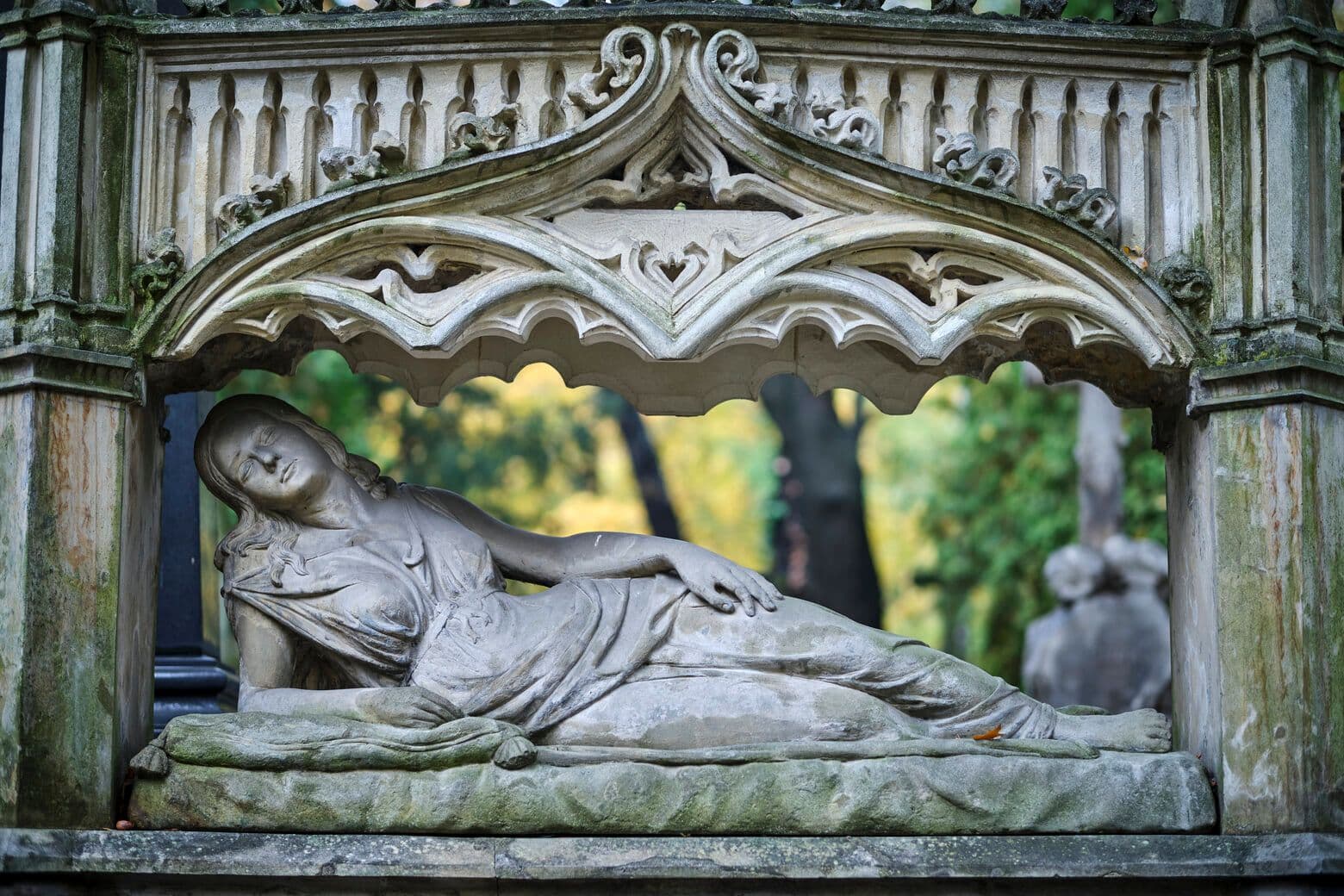
Interestingly, the sculptures in the Potocki Mausoleum were made by one of Poland's greatest Neoclassical sculptors—if not the greatest—Jakub Tatarkiewicz. It is therefore no surprise that Cecylia Krysińska's tomb, considered one of his most interesting works, was long thought to be entirely complete. It was created in 1845, nine years after the one at Wilanów. The figure on the sarcophagus was modeled on the statue of Sleeping Ariadne, once known as the Dying Cleopatra. Sleeping Ariadne, whose Roman copy from the turn of the first and second centuries is in the Vatican Museums, first inspired Monaldi—or perhaps his patrons, Maria Radziwiłł and her brother Feliks Gawdzicki. They commissioned an Ariadne, with the features of Prince Mikołaj's wife, to be carved in Carrara marble. Tatarkiewicz, who traveled to Szydłowiec to collect the stone, must have seen it. It is not known whether the sculptor suggested this solution to the young widower, or whether Zygmunt Krysiński himself—a learned and well-educated man—commissioned it. The fact that a canopy with a Tudor arch, as at Wilanów, was unexpectedly discovered in 1978 supports the idea that he had a say in the final design of the tomb. Tatarkiewicz himself would probably not have chosen such a model; he was most comfortable working with pure Neoclassical forms. He did not count Krysińska's tomb among his finest works either, although it is undoubtedly an outstanding piece. It is well worth getting to know it better. Later, when circumstances permit, visit Szydłowiec, listen to the romantic (of course!) story of Maria and Mikołaj Radziwiłł's love, and take a close look at the tomb. You will be able to notice the similarities and differences. Certainly, the faces of the two statues are different, just as these two women were different. They were undoubtedly united by one thing—the love their beloved husbands had for them.