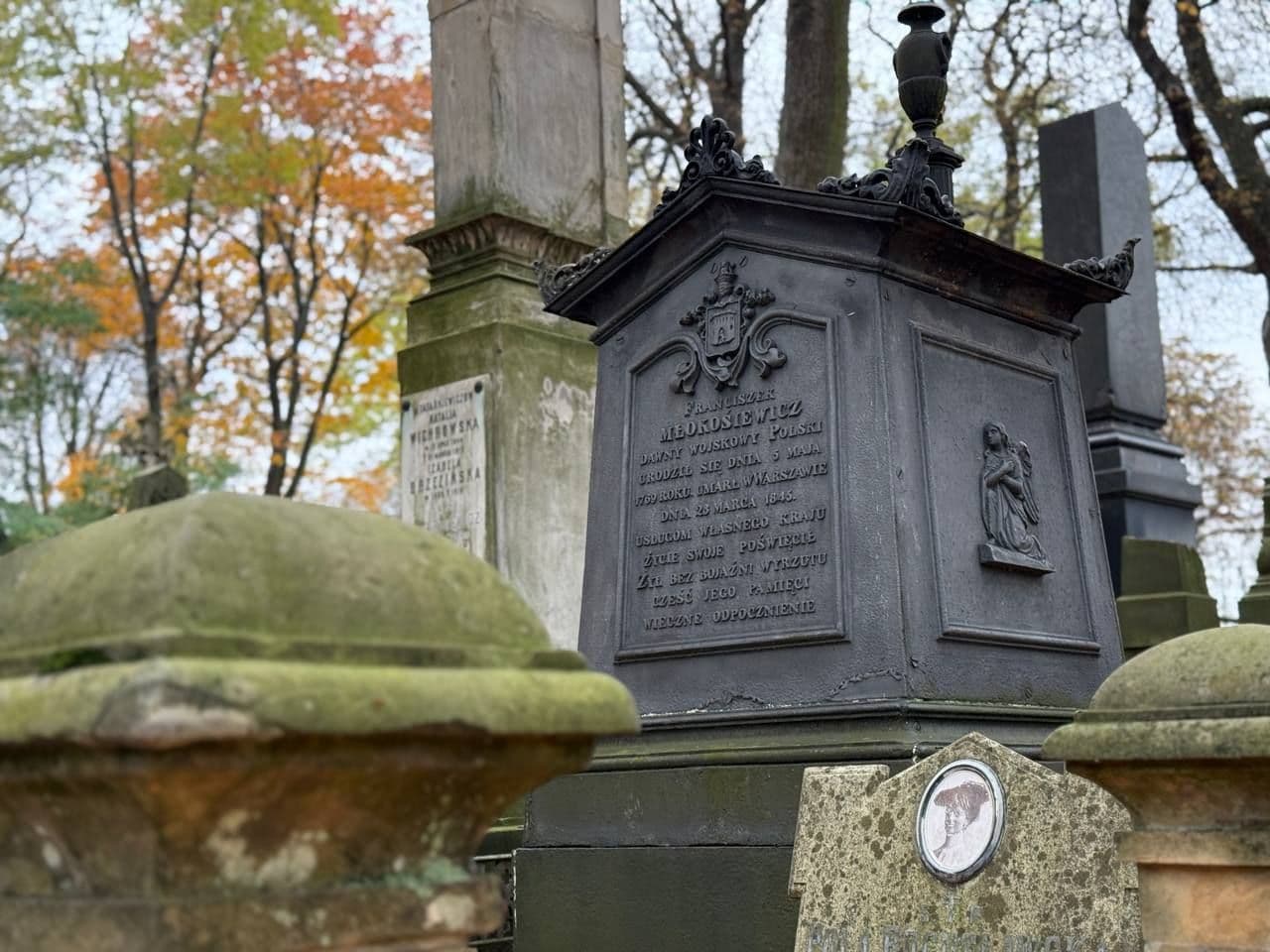

Franciszek Młokosiewicz is the only Polish military officer from the turn of the 18th and 19th centuries who, during his many years of service, rose from private in Piotr Potocki's 7th Infantry Regiment to brigadier general during the November Uprising. He owed his promotions to his steadfast service, earning them on successive battlefields across Europe. During his long military career, he fought in Poland, Russia, Germany, and Spain.
He came from a family of artisans. He was born on 5 May 1769 in Koźminek, near Kalisz. He began his education there and continued it in Kalisz. He joined the army at the age of 20, becoming a private in Piotr Potocki's 7th Infantry Regiment. He evidently showed an aptitude for military service, as just a few months after joining the regiment he was promoted to corporal, and in the spring of 1790 to sergeant. His first wartime campaign was the 1792 war with Russia in defense of the Constitution, in which his regiment fought, among other places, at Zieleńce. Młokosiewicz's next campaign was the Kościuszko Uprising, in which he took part as a soldier in the 17th Infantry Regiment and was promoted to second lieutenant.
Franciszek Młokosiewicz returned to service in December 1806, when, after the Prussian forces had been defeated, the French army entered Polish territory. He became a lieutenant in the newly formed 4th Infantry Regiment and took part in the 1807 campaign, in which he would become one of the most famous soldiers. For this campaign, he received the Virtuti Militari Order and was promoted to captain.
In 1808, he went with his regiment to Spain, like many Polish soldiers, to take part in the long and bloody war on the Iberian Peninsula. He spent as many as four years there, taking part in numerous battles and skirmishes: at Ciudad Real, in the Battle of Ocaña, and at Fuengirola.
The last of these battles is sometimes called the infantry's Somosierra. Although the engagement was relatively small, it was significant because, if successful, it would have led to the capture of Málaga by English and Spanish forces, which could have changed the course of the war in Spain.
Młokosiewicz took part in the Russian campaign in 1812. In 1813, he was seriously wounded at the Battle of Leipzig. In the Congress Kingdom, he served as a major in the Invalid Corps, and later went to his wife's estate near Szydłowiec.
After the outbreak of the November Uprising, he returned to service and was promoted to colonel in 1831. After the Battle of Kłuszyn, he became a brigadier general.
During the assault on Warsaw, he fought at Wola. He then requested his dismissal and, taking advantage of the amnesty, swore an oath of allegiance to the tsar so that he could return to his estate in Omięcin, near Szydłowiec.
In 1844, the tsar granted him a noble title and the Fuengirola coat of arms.
He died in Warsaw on 23 March 1845.