
A Warsaw publisher of Sienkiewicz and Verne
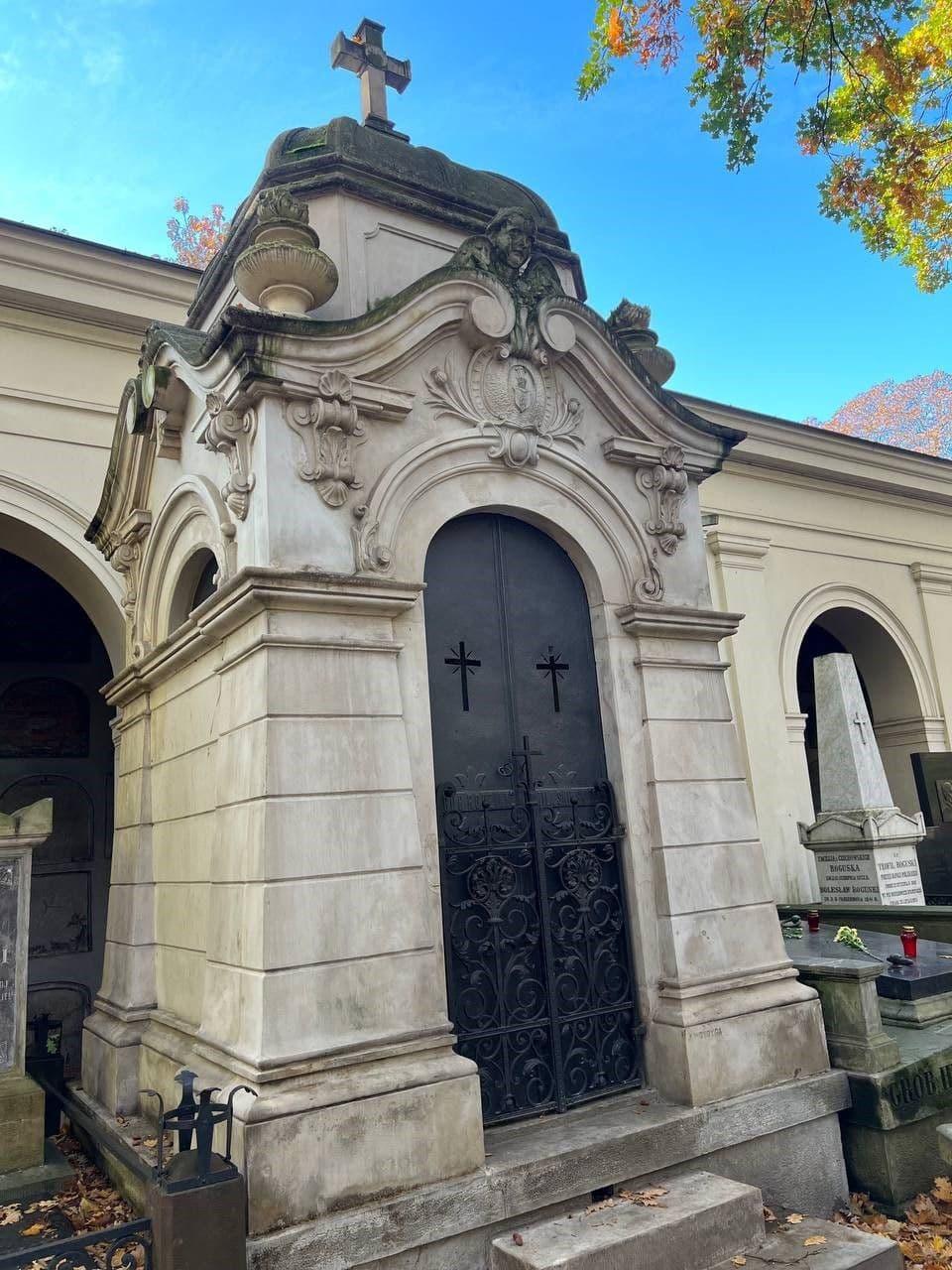
In the row beneath the catacombs stands an impressive chapel, the burial place of Emil Skiwski. The imposing tomb, with its distinctive dome, contains a marble altar and a medallion depicting Christ's face, behind its iron gates. This is the resting place of Emil Skiwski, a Warsaw printer and publisher.
In the 19th century, around 80 percent of the population in the Russian partition could not read or write. Yet since the Enlightenment, writers, books and the press had been steadily gaining importance. More and more books were being published, and the printing industry was thriving. There were, therefore, people willing to invest in the industry. One of them was Emilian Konstanty (Emil) Skiwski. He was born on 17 March 1836 into a landowning family. His father owned an estate near Łomża. Little is known about his youth; most likely, he worked on the family estate. The work must have paid well, since Skiwski arrived in Warsaw at the age of 28 and, in 1874, bought a printing house on Elektoralna Street. Perhaps he sold the family estate to raise the capital? We also do not know what education he received or whether it was connected with his plans to run a printing house. His decision proved sound: the business grew and received an increasing number of commissions. In time, Skiwski's printing house (which had moved to Chmielna Street) was carrying out work for Warsaw's most important publishing houses, including Arct and Gebethner & Wolff. He printed scientific and religious books, as well as novels, including works by Sienkiewicz and Verne. Emil Skiwski did not limit himself to printing other people's writings and books. In 1876, he bought Tygodnik Mód i Powieści ("Fashion and Novels Weekly"), a magazine aimed at women, although it covered a much broader range of topics. Later, he also acquired the educational weekly Przyjaciel dzieci ("Children's Friend"), aimed at children. At the turn of the 20th century, it was one of the most important Polish-language magazines of its kind.
Skiwski also published Biesiada Literacka ("Literary Feast") and the popular science magazine Wszechświat ("Universe"). Biesiada Literacka was a political and literary weekly that published works by Ignacy Kraszewski, Adam Asnyk, Deotyma, Henryk Sienkiewicz and Bolesław Prus. It also featured translations of works from world literature, including those by J. F. Cooper, W. Goethe, G. Maupassant and M. Twain. Maria Skłodowska was among the contributors to Wszechświat, which is still published today and is the longest-running Polish popular science magazine.
A remarkable yet tragic figure was Emil Skiwski's grandson and namesake, Jan Skiwski's son, Jan Emil Skiwski. Born in Warsaw in 1894, he was a writer, journalist, translator and soldier in the 1920 war. He served as vice-president of the Polish Writers' Union and was a member of the board of the Polish PEN Club. He died in 1956, living under the assumed name Rogalski, forgotten in distant Caracas, where he was also buried. In the Polish People's Republic, he had been sentenced to life imprisonment for collaborating with the Third Reich, and his works were censored and withdrawn from libraries. The ill-advised decisions he made during the Second World War led this member of a distinguished family of Polish publishers to such a tragic end. Skiwski was an original journalist and writer who followed his own intellectual path. Even before the war, he made no secret of his fascination with fascism. After the outbreak of war, he decided to continue publishing in the Polish-language press issued by the German authorities. When the Germans discovered the graves of Polish officers in Katyn, Skiwski accepted a German offer to join a commission that would observe the exhumations at the site. Unlike Józef Mackiewicz and Ferdynand Goetel, however, he made this decision without the consent of the Home Army authorities. As a result, he was boycotted and condemned by the literary community. Toward the end of the war, he fled the Red Army and went with his family to Bavaria, where he met Governor Hans Frank. After many vicissitudes, he eventually changed his name and left for Venezuela.