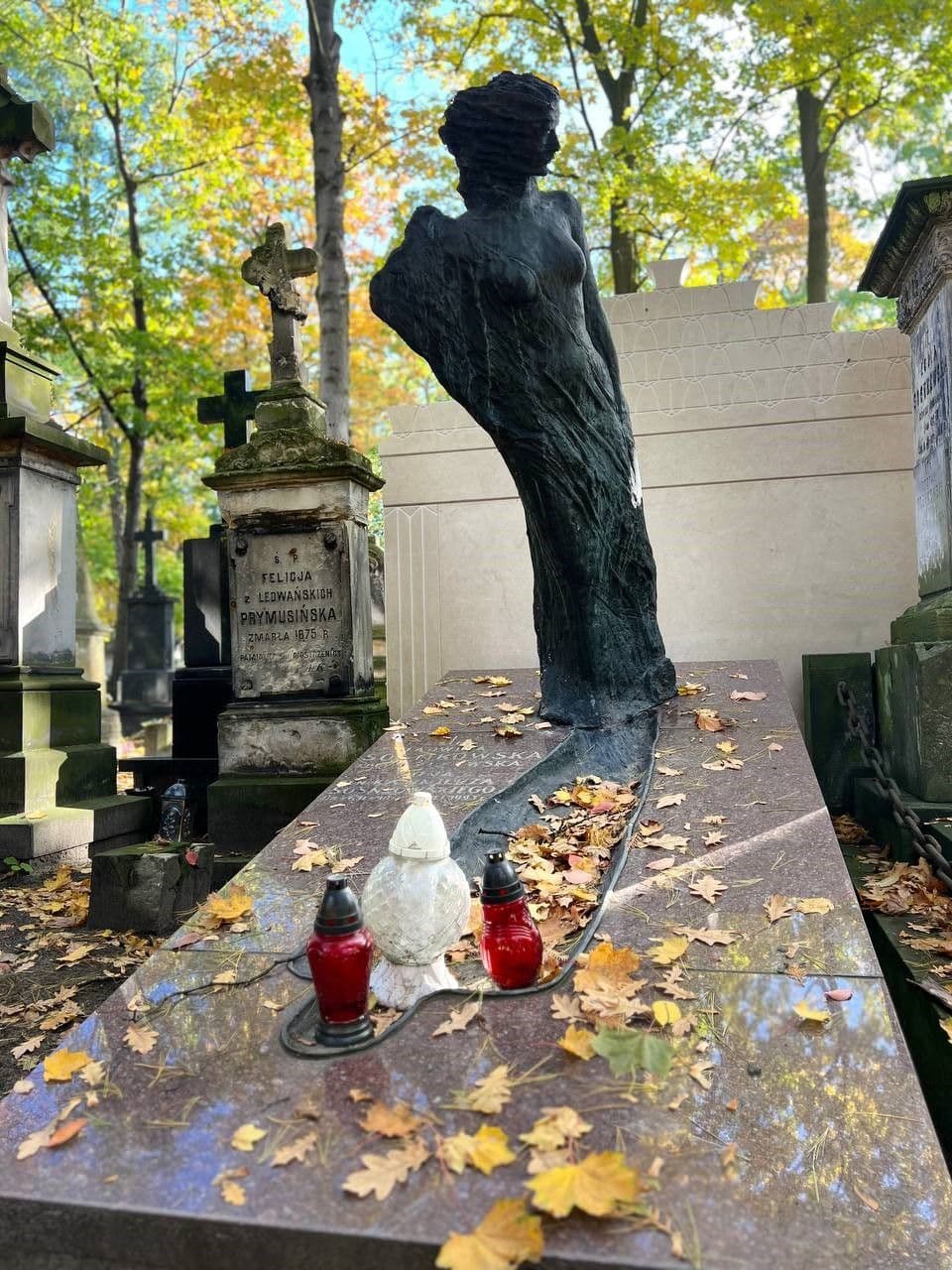

The general and Commander-in-Chief's lifelong companion
Jadwiga Sosnkowska was the second wife of General Kazimierz Sosnkowski. He was one of Marshal Piłsudski's close associates and one of the most intelligent generals of the Second Polish Republic. His wife accompanied him throughout his professional life, both when he enjoyed success and in difficult times—for example, when he had to work on a farm to support his family because he could not leave Canada.
Jadwiga Sosnkowska, née Żukowska, was born in St. Petersburg in 1901 into a Polish family that upheld patriotic traditions. She was brought up in this same spirit. Her father, Władysław Żukowski, held a doctorate in mathematics and was an industrialist. He was active in politics and served as a member of the Second and Third Dumas. Through her mother, Jadwiga née Jałowiecka, she was closely related to Józef Piłsudski. At the beginning of the 20th century, around 50,000 Poles lived in the capital of the Russian Empire. They formed a sizeable community, accounting for 3.5 percent of the city's population; only Russians and Germans were more numerous. Numerous Polish organizations operated in St. Petersburg. Polish newspapers were published, and three Polish banks were in operation. After 1905, more than thirty Polish sports, social, and religious organizations operated in the city. St. Petersburg was considered the most Polish of Russia's cities.
In addition to managing the household, Jadwiga's mother worked among Polish children living on the Neva. The Żukowskis are believed to have helped Józef Piłsudski escape from a St. Petersburg psychiatric hospital in 1901, where he had been placed under observation after feigning mental illness. The parents decided that their daughters (Jadwiga had an older sister, Zofia) would follow the curriculum of the Ursuline Sisters' school in Kraków. While the girls lived in St. Petersburg, they were educated at home. Once a year, in May, they went to Kraków to sit the exams for the next grade. The First World War found the Żukowski family in St. Petersburg. Władysław Żukowski died in 1916. In 1918, his wife and their two daughters left the city, as did a large part of the Polish community on the Neva. They arrived in Warsaw in early November 1918. A few days later, on November 10, Józef Piłsudski, released by the Germans, arrived in the city. Jadwiga's mother then renewed her contacts with the
Commandant. As a result, the young Miss Żukowska met a close companion of the Marshal, who had been interned with him in Magdeburg. The wedding of twenty-year-old Jadwiga and Kazimierz Sosnkowski, who was sixteen years her senior, took place on April 30, 1921, at Warsaw's Archcathedral. In place of her late father, Józef Piłsudski escorted the bride to the altar.
Jadwiga was Sosnkowski's second wife. His first wife, Stefania, developed a severe mental illness after the death of their ten-year-old daughter Zofia, who was killed by the Spanish flu, which was devastating Europe. The marriage was annulled, allowing the future Commander-in-Chief to marry Jadwiga. They had five sons, four of whom became military officers.
In addition to managing the household, Jadwiga also performed protocol duties. She was a very active person in her own right. She rode horses, swam, practiced track and field, and could even pilot an aircraft.
The outbreak of the Second World War separated the family. Her husband and sons made their way to the West. Jadwiga remained in Warsaw, where she worked as a nurse at Ujazdowski Hospital until March 1940. After the war, they lived in Canada (where General Sosnkowski was de facto interned until 1949). After the general's death in 1969, Jadwiga Sosnkowska settled in Spain. She died on January 11, 1993.