
General and inventor
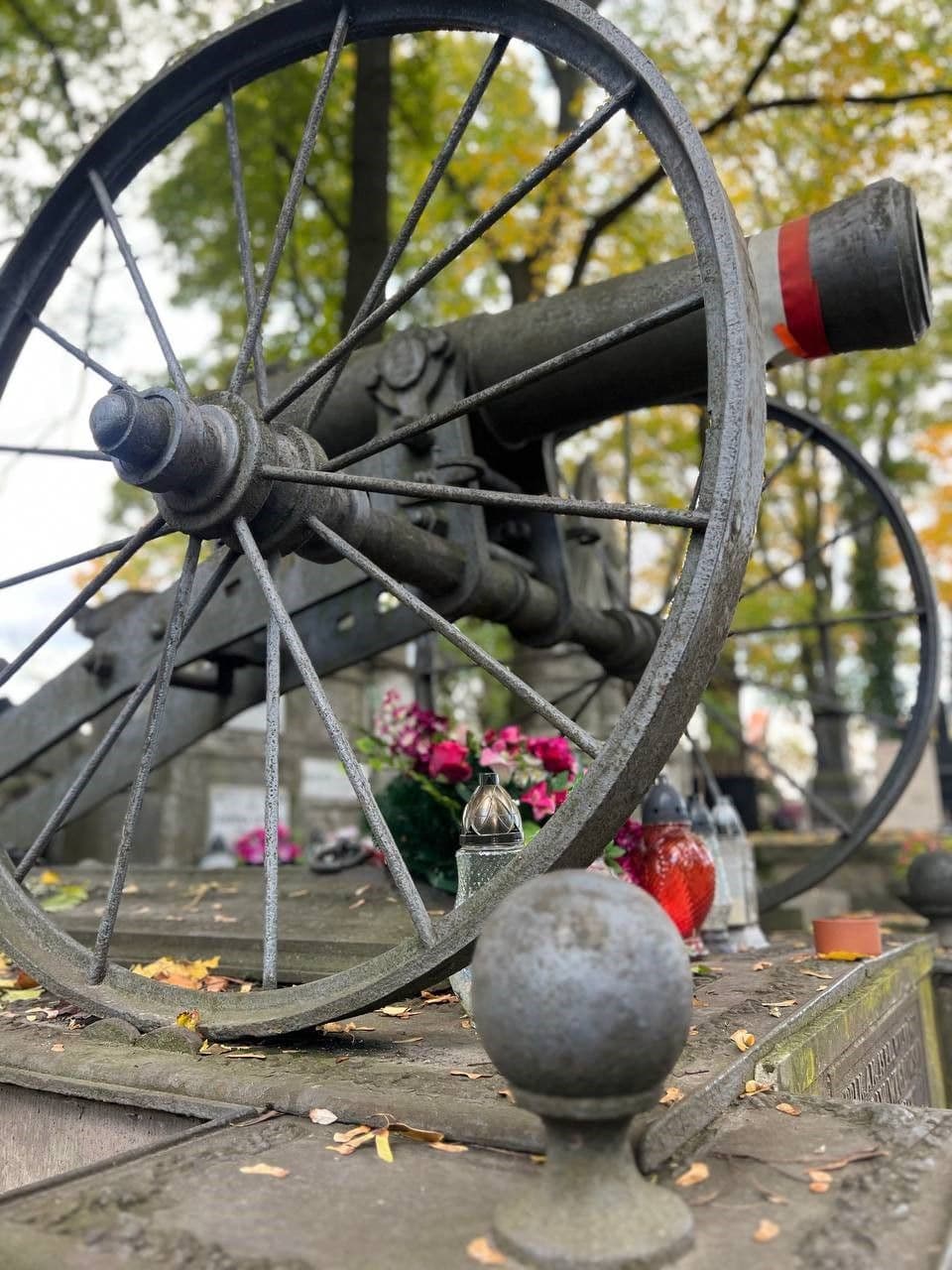
Among the many and varied monuments at the Old Powązki Cemetery, one object catches the eye: a cannon—the only one of its kind on the cemetery grounds.
It stands near the wall along Okopowa Street. The barrel is mounted on an iron carriage and points towards Spokojna Street. And it was this very carriage that was a source of pride for General Węglowski, who was also buried in a partially iron tomb.
Named after its creator, this was the first iron carriage in the Russian army and became known as the Węglowski carriage. Its creator had a successful military career that spanned three different armies and took him from gunner to general. At the time, serving in different armies was not unusual. Some military men changed sides even more often than our protagonist.
The creator of the carriage we can see at Powązki began his military service in 1806 in the French army, with the rank of gunner. He then served in the Polish Army from 1815 to 1830 as an artilleryman at the Zamość Fortress. In 1830, he was promoted to the rank of second lieutenant in the artillery.
After the fall of the November Uprising, he served in the Tsarist army, rising to the rank of major general of artillery. While serving as a colonel, Węglowski designed an iron fortress gun carriage known as the "Węglowski carriage." It was the first iron carriage in the Russian army and was used mainly in coastal and fortress artillery. In addition to the carriage, he was responsible for other inventions, including civilian ones, among them an iron forged-iron wheel for a horse-drawn cab, which won an award at an exhibition in Warsaw.
Military tradition in the Węglowski family was evidently passed down from generation to generation. The son of General Jędrzej Węglowski, Dionizy Adam Węglowski, joined the Tsarist army, where he was promoted to the rank of captain. He left the army in 1854. When the January Uprising broke out, he took part in it. General Taczanowski initially appointed him commander of the armed forces in Kalisz County, but he was quickly dismissed from the post due to his lack of activity. He fought with the rank of major in Franciszek Parczewski's unit, commanding troops in the battles of Kruszyna and Rudniki. After the uprising was defeated, he went into exile, where he was actively involved in public affairs. He eventually settled in Galicia and died in Lviv in 1881.
Jędrzej's great-grandson, who was buried in the same grave, was also a soldier. He graduated from the infantry cadet school. During the September Campaign, he fought in the Kielce region with the rank of second lieutenant, and later took part in the defence of Warsaw. During the occupation, he commanded the Puławy district. During Operation Tempest, he was one of the commanders of the attack on Puławy on 26 July 1944. In August, he was arrested by the NKVD and sent to camps in Russia. He returned to Poland in November 1947. Arrested by the Security Office in 1952, he was tortured and sentenced to 15 years in prison. He was released in 1956. Later rehabilitated and promoted to the rank of lieutenant colonel, he died in 1967. He was awarded the Virtuti Militari Order and the Cross of Valour.