
Józef Elsner
"Last Tuesday—as reported by the Kurjer Warszawski, No. 91, of April 7—a wedding took place in the Loreto Chapel in Praga: that of Mr. Wincenty Kostecki and Miss Ludwika Nidecka, granddaughter of the distinguished Józef Elsner, former Director of the Opera and Rector of the Music Conservatory. He was present at the holy ceremony and bestowed his patriarchal blessing on the newlyweds. After the ceremony, the closest relatives of the bride and groom and a small number of true friends were received by Mrs. Emilja Nidecka, the mother, with warm hospitality in her own home, where, seated at the table, they raised heartfelt toasts to the young couple's good fortune and offered their sincere wishes for a happy life together for many long years."
This notice, published in April 1853 in the Kurier Warszawski, is quoted by Janina Siwkowska in her beautiful, highly detailed work "Nocturne, or the Family of Fryderyk Chopin and Warsaw in the Years 1832–1881." Visitors to Warsaw in a hurry, and those uninterested in the life of the author of the words found in every school textbook: "Chopin Friderik – exceptional
ability, musical genius," probably remember only the plaque on the Dziekanka building on Krakowskie Przedmieście, stating that Józef Elsner lived and worked there.
This is true, as are the other Warsaw addresses. Nevertheless, he considered the estate he had acquired through his own hard work, and which gave him great joy, to be his place on earth. It lay on the other side of the Vistula and was called—as one might expect—Elsnerowo. In 1951, this area was incorporated into Warsaw, and Elsnerowo is now administratively part of Praga Północ. In 1853, it was Elsner's and his family's actual address, hence his granddaughter's wedding at Our Lady of Loreto. The family of the prodigy's brilliant pupil was present at the celebration; Elsner was exceptionally close to them. He had much in common with Chopin's father. Both had come to Poland and embraced it as their homeland. Józef was German by birth, born on June 1, 1769, in Grottkau in Silesia, although he took great care to play down his German origins, explaining that his family had come to Poland back in the days of the Vasa dynasty. Stanisław Szenic repeated this word for word, while the cautious Adam Zamoyski added "supposedly" to this information in his excellent biography "Chopin."
Józef Elsner began learning Polish only after completing his studies in Wrocław and working in Brno. It was not until he went to Lviv in 1792 and began collaborating with Bogusławski that he took up the study of Polish, committing himself to it so wholeheartedly that by 1818 he had published "A Treatise on the Metrical and Rhythmic Qualities of the Polish Language." His wives also helped him with his studies—Klara Abt, whom he married at the Lviv Cathedral Basilica and who sadly died giving birth to their daughter Karolina, and his second wife, Karolina Drozdowska. He met Karolina in Warsaw, where Wojciech Bogusławski had brought him and appointed him Director of Music at the National Theatre. Contrary to the old saying, "She who marries a widower is as foolish as a sheep," Miss Drozdowska, an excellent singer, celebrated her golden wedding anniversary with Józef (the celebration was held at the Resursa, with the Chopins once again among the guests), and their marriage was considered truly happy. She died two years before her husband and was buried in Kamionek.
Elsner himself, remembered as the brilliant teacher of a genius, is unfairly overlooked as a composer (around 38 stage works, including the operas "Leszek the White" and "King Łokietek," and around 120 religious works), as the founder—with Father Cybulski—of Warsaw's first music engraving workshop, and as the initiator and Rector of the Main School of Music, thanks to which Warsaw now has the Fryderyk Chopin University of Music. We will try to tell you more about the complicated history of the institution and its professors in the next educational trail we are working on, which will be devoted to the University of Music.
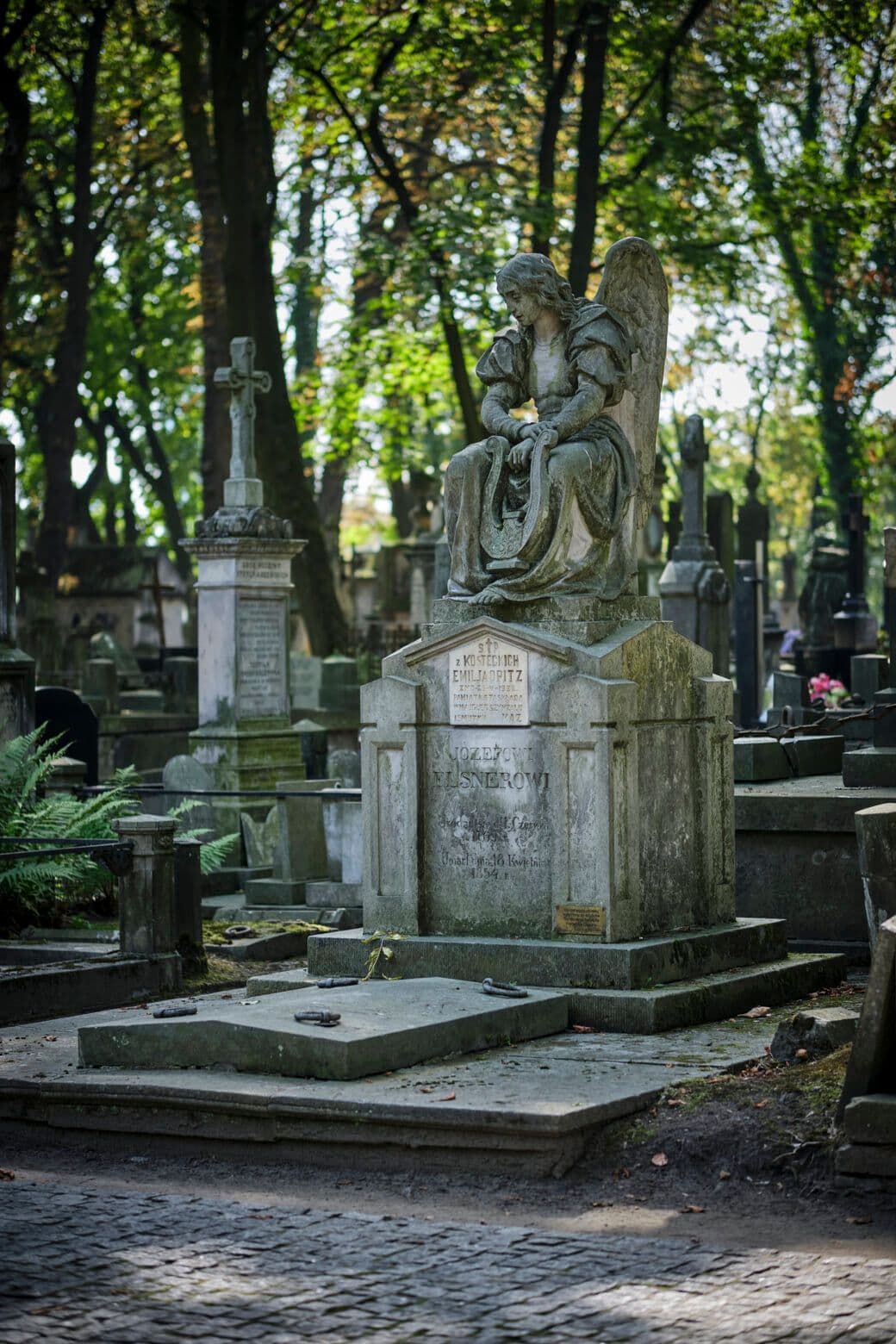
Józef Elsner died in Elsnerowo on April 18, 1854, and was not laid to rest beside his beloved wife in Kamionek, but at Powązki. The statue for his grave—an angel holding a lyre with a broken string—was made in Menzel's workshop on Elektoralna Street by the sculptor Wojciech Święcki.