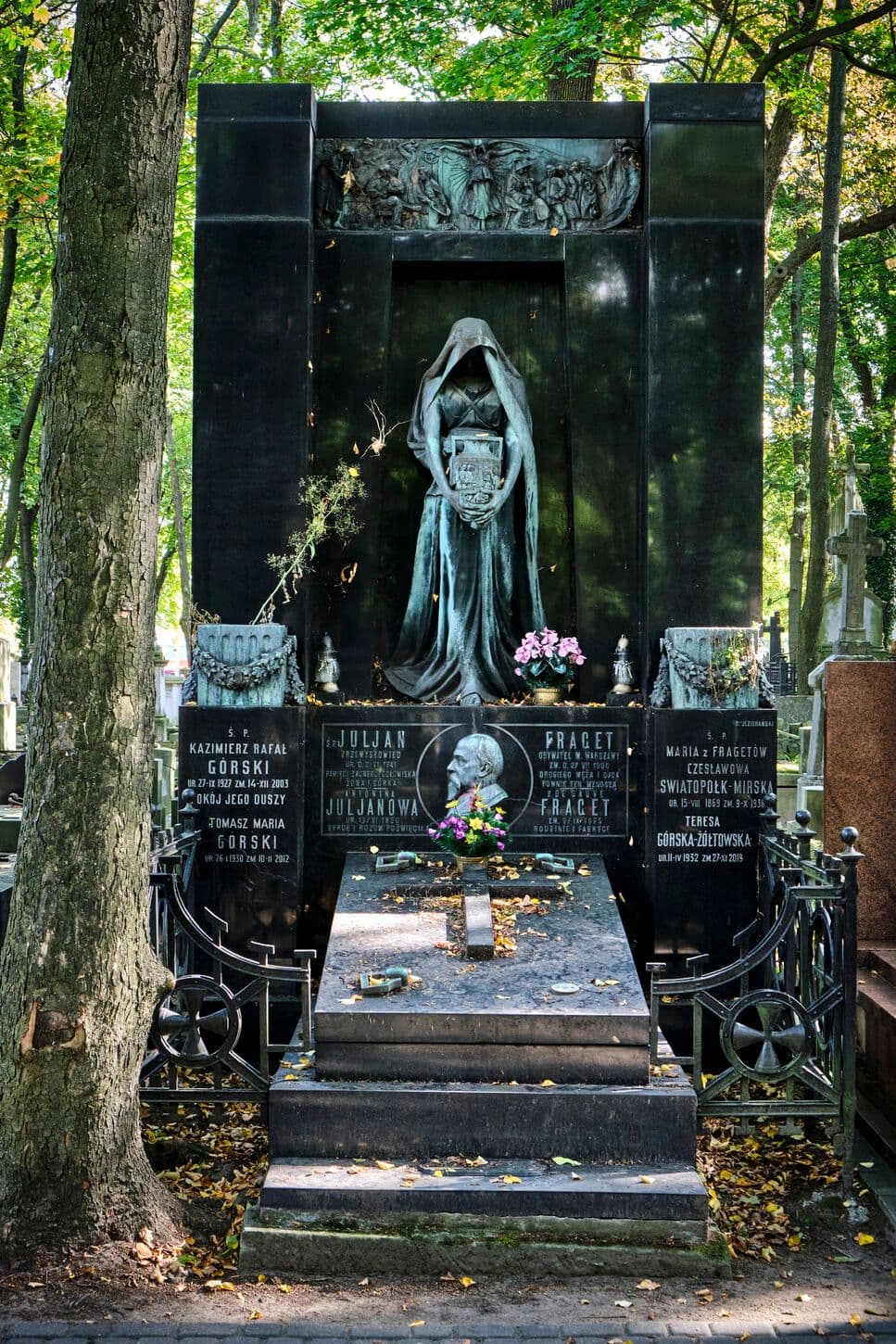

Julian Fraget's tomb
Above the slanting tomb slab, adorned with a simple cross and fitted with four handles, rises a granite wall resting on a plinth, flanked by pillars projecting from its face. At the base of the pillars, fluted surfaces decorated with garlands further emphasize the character of this architectural and sculptural structure. It is crowned by a frieze depicting scenes of learning and work.
At the center of the wall is a niche—a gateway—against which stands a statue of a woman in antique robes, her head covered by a veil. She holds a lachrymatory in her hands. Few people look closely at the lachrymatory, which is crowned by a scene depicting the visit of three Angels to Piast the Wheelwright. We can see that certain symbols never grow old when we talk to students who, after approaching the tomb, say—without worrying about their inelegant language: "Oh, that's what I look like when I've had enough; I'm about to pull a hood over my head too."
After visiting, then, they often remember the symbol of sorrow best. On the axis of the statue, on the plinth, is a profile of Julian Fraget, surrounded by family inscriptions.
The Fragets were an extraordinary family, and we will certainly return to them more than once. For now, however, allow us to turn to the creator of this granite monument, the sculptor Bolesław Jeziorański (1868–1920). Although art historians appreciate his talent, he never received a monograph of his own, as Ewelina L. Perzyńska–Jelska rightly lamented in one of her studies, despite creating outstanding works and working mainly in funerary art. In Warsaw, his work can be found at Powązki Cemetery, the Evangelical-Augsburg and Evangelical Reformed Cemeteries, as well as in the Catholic cemeteries of Radom, Lublin and Vilnius. Bolesław Rościsław Jeziorański was the nephew of Jan Jeziorański, a member of the authorities of the January Uprising, who was sentenced to death alongside Romuald Traugutt. He himself studied under Gerson and at the Académie Julian in Paris. Without Fraget's patronage, however, he would not have been able to choose his commissions and work with such an excellent material. Fraget's tomb was a token of gratitude for years of support. Perhaps more of the artist's works will yet be found in cemeteries, since the sculptures at his home in Głuchy were destroyed by the Bolsheviks. When the artist and his family returned from their wanderings, he saw not only the ruined manor house, but above all the smashed sculptures. He died on September 13, 1920.