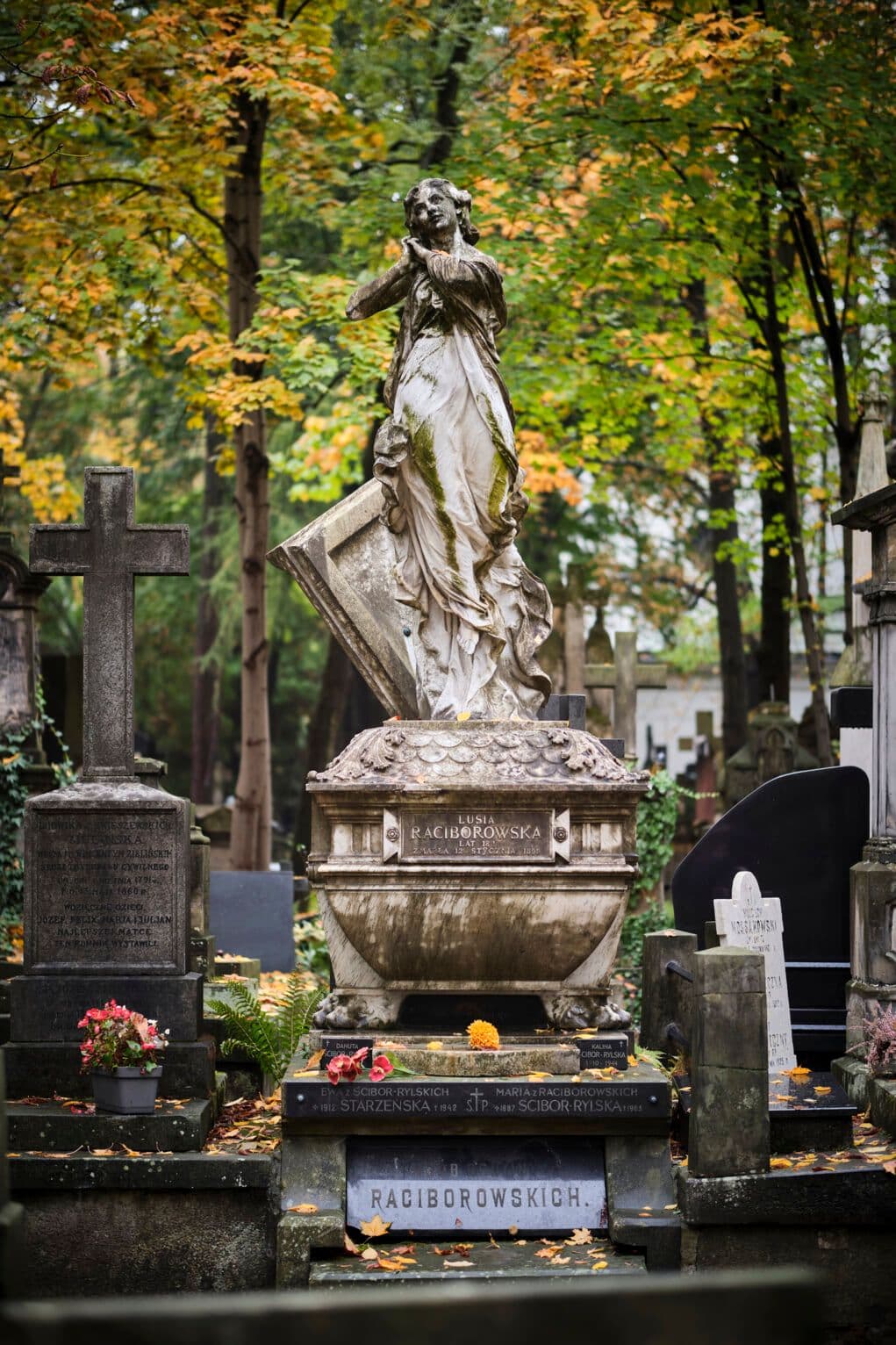

Lusia Raciborowska – how much remains to be discovered
Maria Irena Kwiatkowska, an art historian and distinguished expert on Polish sculpture, quoted Kazimierz Ostrowski's daughter, Halina Ostrowska–Grabska, in her book "Warsaw Sculptors of the 19th Century". Ostrowska–Grabska lamented the miserable fate of Polish sculptors: "not only do their efforts exceed their means, but their achievements and results are lost forever. They are lost not only because of material poverty, which makes it impossible to preserve sculptures in durable materials, and not only because they are destroyed by wars that devastate the country, its cities and its resources, but also because of a certain carefree indifference on the part of society towards its own culture."
The Positivists also complained bitterly about the admiration for all things foreign and the neglect of homegrown talent. They addressed this in their journalism, novels and short stories, the most emblematic example being Sienkiewicz's "Janko the Musician". Of course, they had plenty of reason, but things were not as simple as they would have liked. A very cursory look through any art history textbook is enough to see how often artists travelled all over Europe, and how much European art gained from this.
In Poland, constant wars and the impoverishment of society made commissions very hard to come by. Local artists, even the most talented ones, had little opportunity to prove themselves. If someone—like Lusia Raciborowska's parents, for example—wanted an exceptionally beautiful gravestone for their child, and wanted it made quickly, presumably to ease their grief even a little, they would turn to someone whose work they knew and whom they trusted to fulfil their commission.
They chose an Italian. His name was Donato Barcaglia (in Polish publications, he is referred to as Donato Barcaglio), and, according to the principal Italian source, "Dizionario degli artisti italiani viventi, pittori, scultori e architetti" (https://books.google.pl/books?id=Zz0bAAAAYAAJ&printsec=frontcover&hl=pl&source=gbs_ge_summary_r&cad=0#v=onepage&q&f=false), he was a Lombard who trained at the Accademia di Brera in Milan. He even exhibited his work in Vienna, so perhaps Lusia's parents first saw his work there and later knew whom to approach? In Jan Maria Rudkowski's excellent study "Powązki Cemetery in Warsaw", we find a beautiful description of the marble monument, along with an explanation of its meaning: the girl is rising from the grave. Perhaps conversations about the Resurrection, intended to comfort Lidka Chwastowska's mother, prompted the creators filming "The Polaniecki Family" to show the grave of the very young Raciborowska? Jan Maria Rudkowski also suggests that Lusia's parents may have drawn on family connections and commissioned a gravestone identical to one erected in the cemetery in Menton. Indeed, there is an identical gravestone in the Vieux Château cemetery. Buried there was the Raciborowskis' neighbour from Podolia, Janina Lewandowska, née Jełowicka. Janina, not Róża Lewandowska, née Jazłowiecka, as one version has it. The Polish Society for the Protection of Polish Monuments and Graves in France clears up any doubts (http://www.tombeauxpolonais.eu/content/lewandowska-z-d-je%C5%82owicka-janina-1885-1912#slideshow-0). They even accompanied their brief inventory description with beautiful, detailed photographs, in which the inscriptions are clearly visible. But... Janina died in 1912, thirteen years after Lusia. It seems unlikely that her parents would have waited so long to erect a gravestone. Unlikely, but not impossible. So we will patiently wait to see what further developments emerge, especially since French websites describing the cemetery mention both our Powązki and Lusia's gravestone. Perhaps someone will come across a clue?