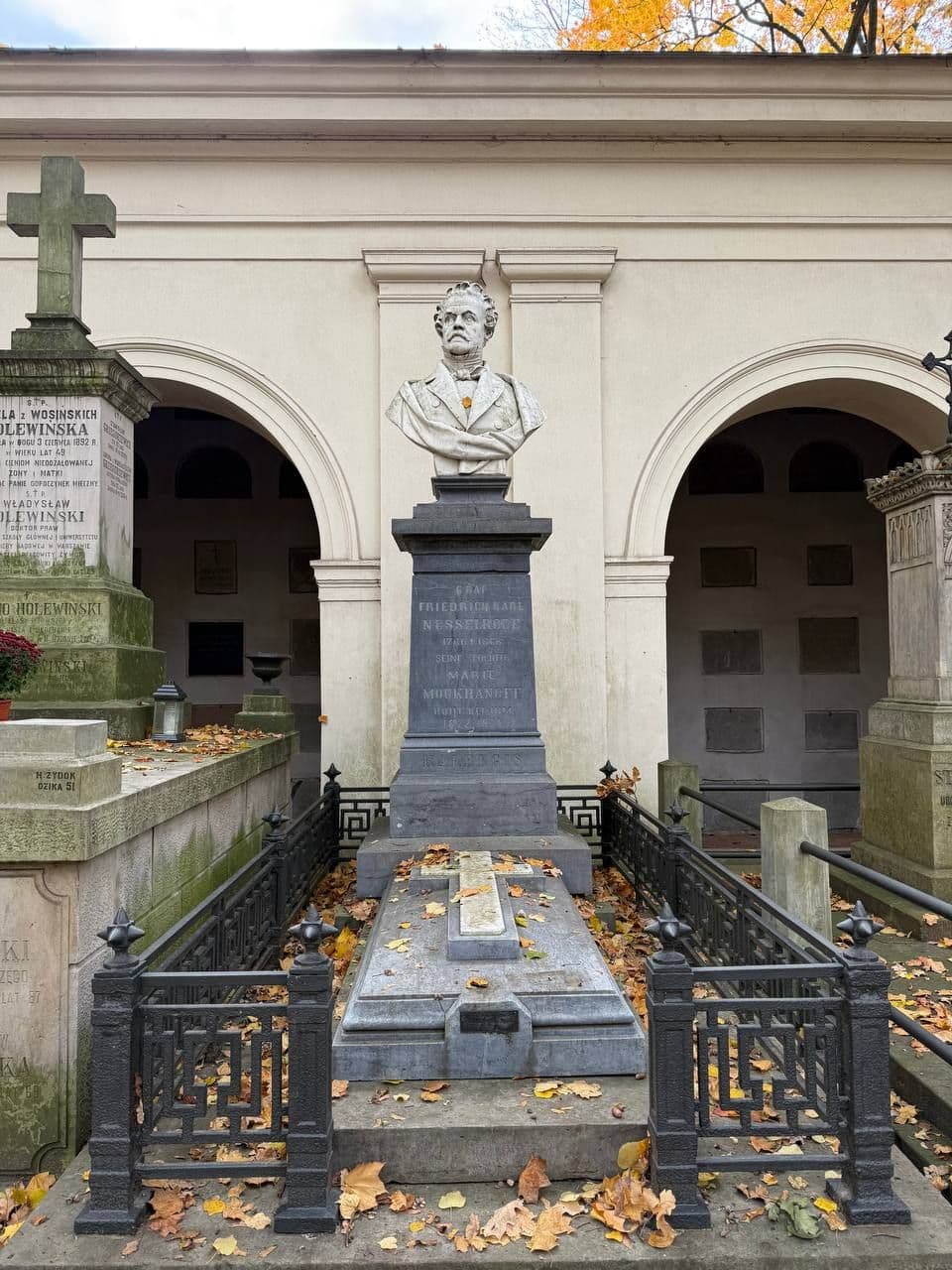

The White Fairy, Catacomb Avenue. A pianist famous throughout Europe, widely known as Maria Kalergis, although she herself used the surname of her second husband, Sergei Muchanow, a Russian in love with Poland who paved the way for Moniuszko. Thanks to her influence, the Grand Theatre was established in Warsaw. Norwid's lifelong love, and the inspiration for "The Ring of the Grand Lady." A pianist, patron of the arts, and organizer of musical life, she was one of the most influential women in European culture of the 19th century. Maria Ludwika Karolina Nesselrode was born in Warsaw to a Polish-German family. Her father, Count Ludwik Nesselrode, was a senior official in the Tsarist administration (head of the 3rd District of the Gendarme Corps), while her mother, Tekla Górska, came from the Polish aristocracy. Her parents' marriage broke down soon after their daughter's birth; Maria was raised by her mother in a Polish-speaking environment and in the Catholic tradition.
At the age of six, she was moved to the home of her uncle, Karl Nesselrode, the foreign minister in St. Petersburg. She grew up among the aristocratic elite, living across from the Winter Palace. At the same time, she was required to convert to Orthodoxy and fully adapt to court etiquette. She gained a reputation for fitting in perfectly with Russian aristocratic society, and was described with ironic affection as "Marie la Polonaise." She was fluent in several languages; after years of not using it, she had to relearn Polish as an adult.
In 1839, she married Jan Kalergis, who came from a Cretan noble family with Byzantine traditions. Her husband was a wealthy official in the Tsarist administration, which ensured Maria's financial stability. A year after the wedding, she gave birth to a daughter, also named Maria. The marriage proved unsuccessful; due to Jan's jealousy, the relationship quickly broke down, and from around 1841 the couple lived apart.
Kalergis's fortune enabled Maria to pursue extensive cultural and philanthropic activities.
Her second husband was Sergei Muchanow, an officer in the Independent Corps of Gendarmes, later chief of police in Warsaw and, from 1868, president of the Directorate of the Warsaw Government Theatres. This marriage was also unsuccessful, but it gave Maria additional influence over the capital's artistic life, particularly over the repertoire of the government theatres.
Maria Kalergis was one of the leading organizers of musical life in the 19th century. Her work encompassed organizing salons and concerts, as well as providing direct financial support and patronage to artists.
Frédéric Chopin – she became his pupil in 1847. The composer held her pianistic talent in high regard. Franz Liszt – they remained friends throughout their lives; Liszt hosted her in Weimar every year, and after her death organized a concert in her memory. Among other works, he dedicated to her his transcription of "Salve Regina de Jerusalem."
Cyprian Kamil Norwid – the poet was in love with her, but his feelings went unfulfilled. They maintained close social and artistic ties. Stanisław Moniuszko – he was one of the artists who owed the most to Kalergis. She organized a benefit concert for him that enabled him to travel to Paris (1858), supported his international contacts, accompanied him on his travels, and also facilitated his meeting with Liszt. Richard Wagner – she was one of the composer's earliest and most important patrons. She supported him financially, rallied European aristocrats to help him (including Empress Elisabeth of Bavaria), and contributed to the Parisian presentation of "Tannhäuser." In 1872, she attended the ceremonial laying of the cornerstone of the Festspielhaus in Bayreuth.
Maria Kalergis performed publicly, often at charity concerts, both in her own salons and in concert halls. She earned acclaim as a pianist with a distinctive interpretive style and exceptional musicianship. Liszt described her playing as unique. Accounts testify to her powerful stage presence and considerable influence over audiences.
She was one of the most important organizers of musical life in Warsaw and Paris. Her salons were among the key meeting places for artists and intellectuals. She initiated events that were both artistic and political in nature. The concert held on January 22, 1865, on the anniversary of the January Uprising, was particularly significant; Moniuszko's "Phantoms" was performed. Repeated several times, the event had a strong impact on Warsaw audiences.
Kalergis spent much of her time in Warsaw, Paris, Baden-Baden, and Italy. She maintained ties with Europe's elite and was also involved in political affairs. She was associated with the Hôtel Lambert. Victor Hugo jokingly called her "the Tsar's spy," while her own father called her "ultra-Polish."
Contemporary accounts noted her fair hair, distinctive style of dress (white lace gowns), refinement, and elegance. She inspired writers (Gautier, Heine), and Cyprian Norwid dedicated several drawings to her.
Kalergis's legacy has been partly carried on by her descendants. Her great-grandson, Richard Coudenhove-Kalergi, became one of the key ideologues of Pan-Europeanism and initiated the choice of "Ode to Joy" as the European anthem.
Toward the end of her life, she found happiness in asceticism; she was buried in a simple white coffin.
She was laid to rest in the tomb she had commissioned for her father, Fryderyk Karl Nesselrode, whose bust crowns the monument.