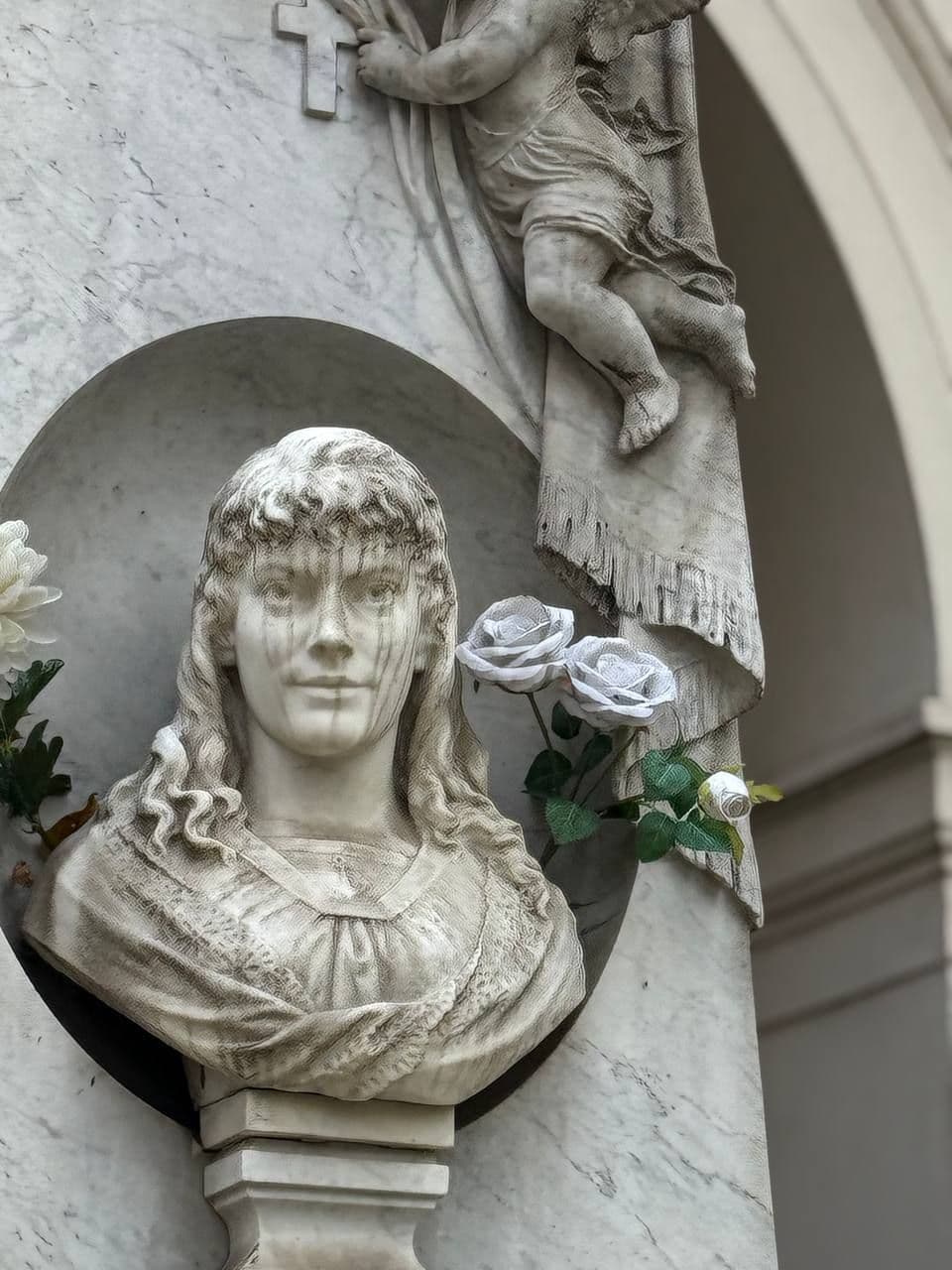

She was born on 23 December 1859 in Warsaw, at Mazowiecka Street. The date of her birth alone was controversial. Her mother had the year 1861 engraved on her grave, the actress herself gave 1860, while the Dictionary of Polish Theatre Biography gave 1858. The date was established by Wisnowska's biographer Agata Tuszyńska (Agata Tuszyńska, Maria Wisnowska. If You Love Me, Kill Me!, Twój Styl, Warsaw 2003), who found her birth record. She was the daughter of a merchant, Oswald Wisnowski, and Emilia née Hoffman. Her father ran a colonial goods store in Warsaw. He died young (he probably committed suicide, and may therefore also have been prone to depression). She most likely also attended Emil Deryng's drama school for a short time.
She was the daughter of a merchant, Oswald Wisnowski, and Emilia née Hoffman. Her father ran a colonial goods store in Warsaw. He died young (he probably committed suicide, and may therefore also have been prone to depression). She most likely also attended Emil Deryng's drama school for a short time.
She made her professional debut on 13 November 1878 in Lwów, playing Jadwiga in the play "A Heart Awoke in Her." She worked at the Lwów Theatre for three seasons, then—from 1881—was associated with the Warsaw Government Theatres (WTR), with a break to spend time in Kraków and make unsuccessful attempts to build a career in Paris (1887–1888). She also appeared as a guest performer in Kraków, Lwów and Łódź, and took part in concerts in Warsaw as a reciter, including at the Musical Society. Wisnowska was cast primarily in the ingénue type, playing young, innocent heroines. The early stages of her career were considered somewhat unoriginal, but she soon became popular thanks to her stage intelligence and charm. Critics noted that her acting could seem more deliberate and calculated than spontaneous, prompting mixed reactions. Nevertheless, she was greatly liked by audiences.
Her most important roles were in comedy and bourgeois melodrama: Zuzanna in "A World of Boredom," Doryna in "Tartuffe," Blanka in "Two Worlds," and Henryka in "Our Allies." In 1884, she attracted critical attention with her role as Puck in "A Midsummer Night's Dream," which she performed with great physical agility and energy.
Wisnowska had striking stage beauty: she was of medium height, with regular features and expressive eyes. Her good vocal qualities and very careful diction were also praised. Her final performance was on 27 June 1890, as Zofia Łaszowska in the play "Oh, Men, Men."
In February 1889, she met a young officer in the Tsar's Guard, Aleksander Barteniew. Their relationship was highly emotional; according to witnesses' later testimony, its dynamics involved jealousy, instability and pressure exerted by the officer.
Barteniew reportedly proposed to the actress, but feared that his family would oppose his marrying an artist seven years his senior. During the investigation, it emerged that he had threatened to commit suicide, while Wisnowska—accustomed to admirers—did not take such declarations seriously. Witnesses stressed that the actress was attached to life and prone to hypochondria, but showed no suicidal tendencies. She was, however, said to have feared the officer's behaviour; notes found in her apartment showed that she was aware of the danger.
The tragedy took place during the night of 30 June to 1 July 1890 in the apartment at 14 Nowogrodzka Street in Warsaw, rented by Barteniew. The actress was found dead on a sofa, surrounded by the remains of a meal and empty alcohol bottles. The autopsy showed that she had been killed by a single shot from a large-calibre revolver, which pierced her heart and lungs.
Barteniew confessed to the crime. In court, he maintained that he had acted at Wisnowska's request, claiming that she had supposedly planned a joint suicide, but witness testimony and the actress's own notes contradicted this. It was established that the officer had acted out of pathological jealousy. The trial, which began on 7 February 1891, attracted enormous public interest; 69 witnesses were questioned. The sentence entailed the loss of his noble rights, eight years of hard labour and lifelong exile to Siberia after serving his term. Wisnowska was buried on 3 July 1890. The clergy refused to provide a religious funeral, regarding the actress as someone who did not conform to the moral standards of the time. Her death became one of the most notorious criminal cases in the history of Polish theatre, leaving a lasting mark on the culture and press of the era.
The tragic end of her life resonated widely in literature: it became the subject of Ivan Bunin's Russian novella "The Case of Cornet Yelagin" and Stanisław Wotowski's Polish novel "Maria Wiśniowska in the Bonds of Tragic Love."