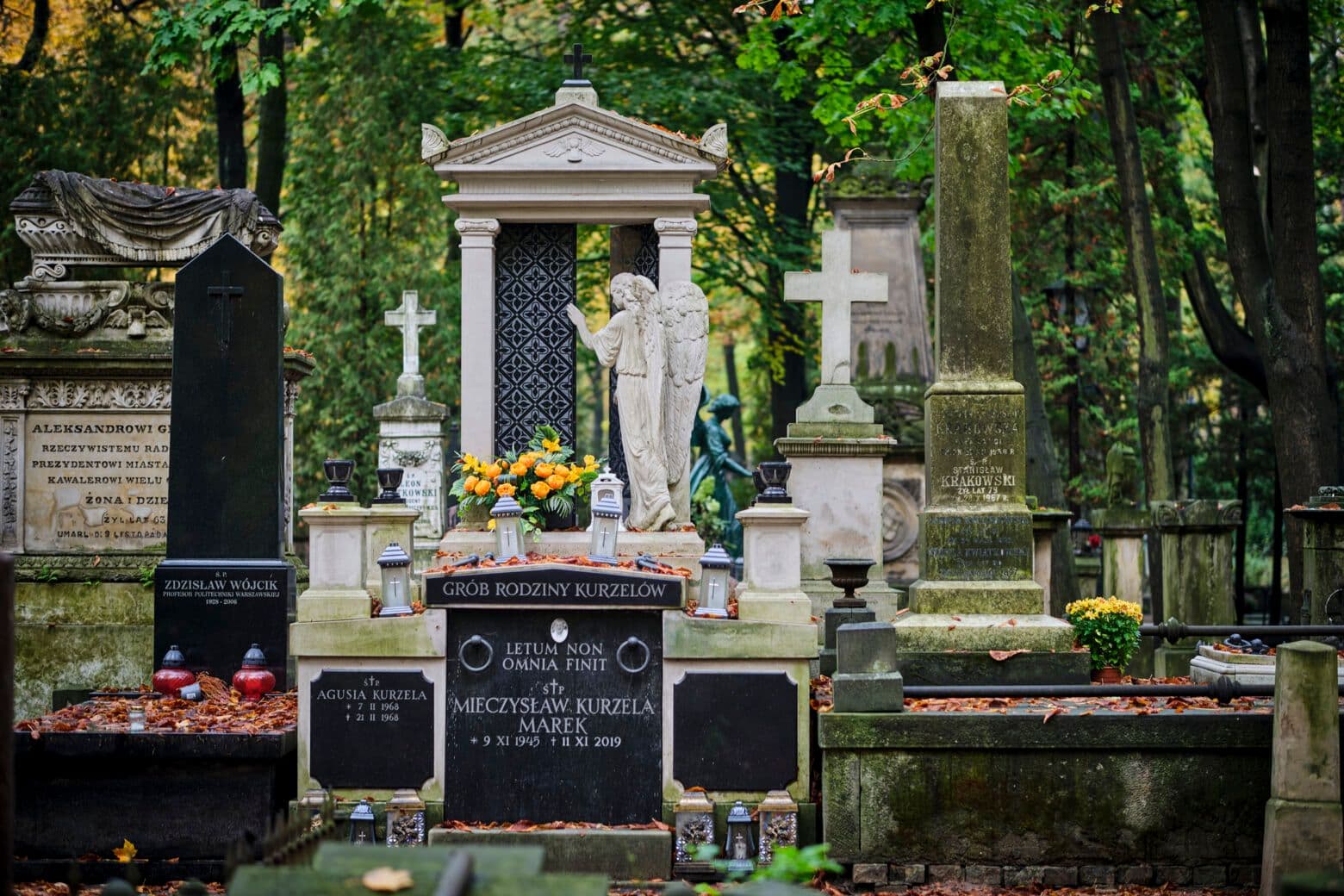

The Kurzela family grave
First, they see an angel. Everyone does. Children and adults turn their heads with interest, sometimes losing the thread of the guide's story. The monumental figure, gleaming white, is draped in flowing robes. Its mighty wings, cascading down along its body, emphasize the figure's verticality and make it seem taller, as do the locks falling onto its shoulders. Only at a second glance do many notice the pediment, resting on two pillars and crowned with five acroteria, and the black door, adorned with stylized flowers set alternately within the lines of a cross. The angel is opening it, resting one hand on its left leaf and the other on the right, already ajar.
This entire architectural and sculptural ensemble stands on a tall rectangular base, topped with a tomb slab fitted with four round handles. The base is flanked by four pedestals crowned with lanterns. Those who linger by the tomb will notice the black plaque on the front wall of the base. Beneath the photograph, and above the inscription identifying the person buried here, is a Latin inscription: LETUM NON OMNIA FINT — Death does not end everything. The same words, taken from the elegies of the Roman poet Propertius, appear on the Venetian grave of the great Russian poet and distinguished translator of Polish literature, Joseph Brodsky. It is no wonder he loved our language and culture so deeply, given his affinity for Propertius, the inspiration for Kochanowski.
The rhythm of the Polish heart is, after all, Latin; our stress falls on the penultimate syllable. This Latin culture is still alive: pagan and baptized, with all that entails, alongside its Greek heritage and Christian vision of the world. It appears in our homes and cemeteries, and the Kurzela family tomb is particularly rich in examples. The portico is inspired by Greece, and among the five acroteria are four palmettes and, fifth, crowning the whole, a cross on a pedestal. These are joined by the ornament on the door, recalling the veil in the Temple of Jerusalem, torn at the moment of the Crucifixion—a veil that, according to Christian legends, was embroidered by the Mother of Jesus, the Co-Redemptrix. The veil is torn, the door is open, and the Messenger no longer stands with a sword, but shows the way with a tender gesture. High above, on the tympanum, an hourglass reminds us that our time on this earth will one day come to an end. And there is the neoclassical cult of beauty, which, according to eighteenth-century theories, was created through the intellect by selecting only nature's most perfect works. In some sense, they believed that beauty would save the world. Inspired by this tombstone, so rich in layers of symbolism, we can reflect on what beauty is and how we understand it.