
Who will find Niusia?
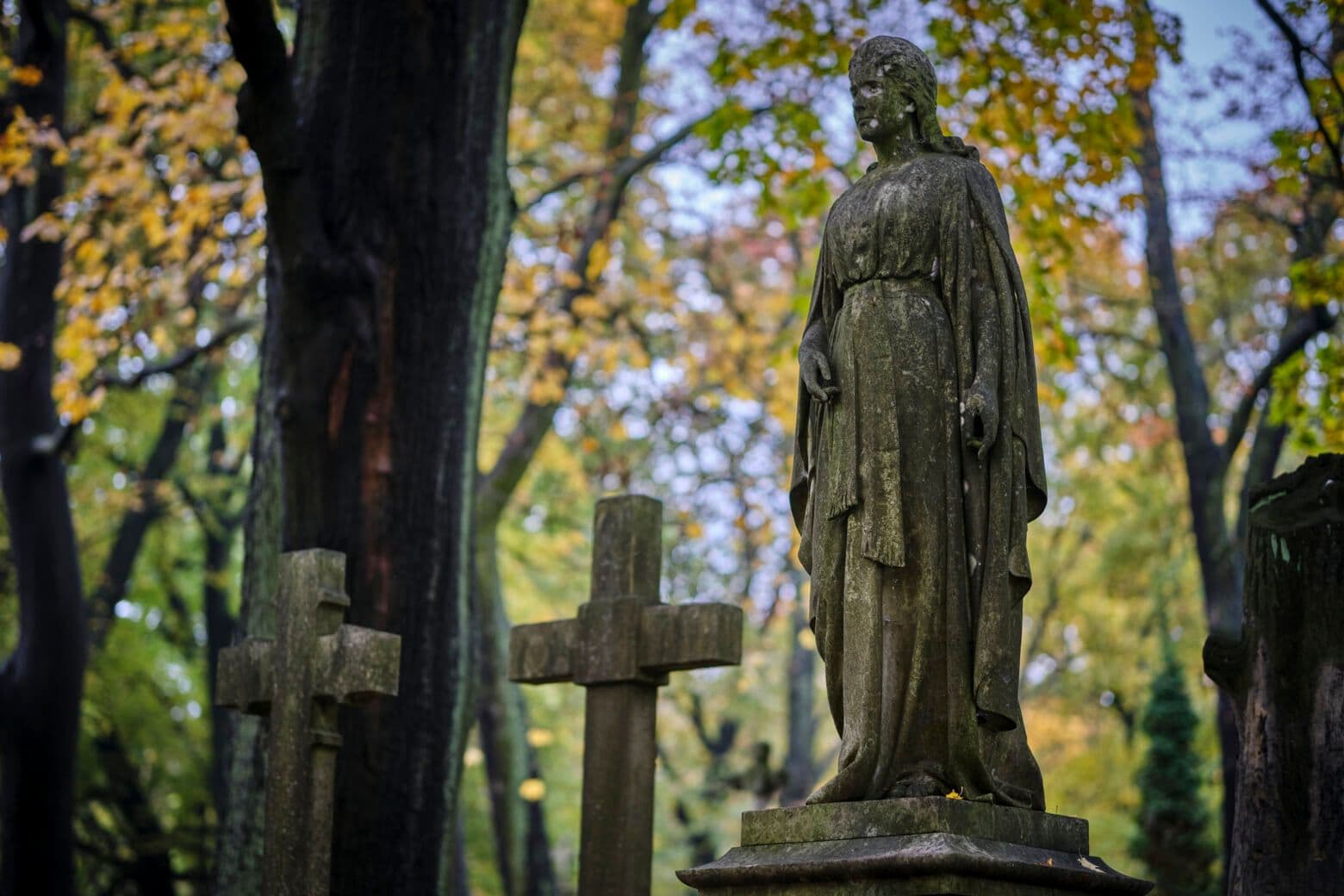
A simple, cube-shaped plinth. On it stands a statue of a young woman in contrapposto. Her right arm is slightly bent, her left hangs by her side. Her simple, long dress is cinched with a fringed sash; her circular-cut cloak and wavy hair falling down her back recall the iconography of Madonnas. But—unless something has been vandalized and forgotten—this is no Madonna. She lacks even one of the characteristic attributes. The inscription on the plinth reads: "To the memory of the one and only beloved Niusia Herman, whose light went out in the twentieth spring of life, 10 June 1894." There is no artist's signature, which was unusual.
Beneath the plinth is a slab bearing the Bończa coat of arms, below which three names are listed: Henryk Skarżyński, Ewa Kossecka and Henryka Kossecka. The only person whose ties to the Herman family have been established is Konstanty Skarżyński of the Bończa coat of arms, from Popowo. After his death in July 1915, he was not laid to rest with his parents in the crypt of the church co-founded by his family, but at Powązki. What is more, he was buried not in a plot purchased for himself, but in the grave of a young woman who was most likely a relative of his wife. In 1888, after all, he married Helena Julia Herman at St Anthony's Church on Senatorska Street. It was undoubtedly a socially unequal marriage.
The chosen one's Lutheran father was a tailor. While religious affiliation did not bother anyone—conversions in either direction were not uncommon—a connection by marriage to an untitled artisan certainly did. The groom was 34 on his wedding day, an advanced age by the standards of the time. But men were considered mature for a very long time, so one could say the count had only just reached the threshold of maturity. The bride, by contrast, had long remained a spinster; she was 32.
The first edition of Balzac's book, which affirmed women's right to love in the spring of their thirtieth year, appeared only fourteen years before Helena was born. In any case, she carefully concealed her birth date: to this day, the Polish Theatre Encyclopedia gives it as sometime between 1850 and 1860. She was an outstanding opera diva, trained in Milan and later employed by the Warsaw Opera. This did not prevent her from performing not only in Kraków and Lwów, but also in Berlin, Frankfurt, Milan, at the Italian Opera in St Petersburg and in Prague. Her roles included Jadwiga in The Haunted Manor, Marguerite in Faust and Aniela in Cinderella, but her greatest role was Carmen.
Unfortunately, illness prevented her from continuing her career. The Polish Theatre Encyclopedia mentioned above also lists Wanda Herman, suggesting that she was Helena's younger sister. One might therefore assume that she was Niusia. But no: Wanda left the stage in 1900, six years after our Miss Herman's death. Yet the death certificate of Helena's father, issued by the Evangelical-Augsburg Parish in Warsaw in 1862, lists only three underage children—Ludwik, Edward and Helena herself. There is no Wanda or any other sister, though that, of course, does not mean there were no more children. If they were apprenticed or sent to live with relatives, they would no longer have been listed as being in their mother's care, since she would not have had to support them. While that might be plausible in Wanda's case, it cannot be so for Niusia: she was born in 1874, twelve years after Helena's father died. Anyone who looks closely at the features of the young woman sculpted in Henryk Żydok's studio on Dzielna Street will see a clear resemblance to Helena. Perhaps some new documents will come to light; perhaps the surviving ones will need to be checked again, since they too sometimes contain errors. Konstanty Skarżyński is sometimes listed as Skarzyński, while his wife appears in the Polish Theatre Encyclopedia as Helena Herman-Skrzyńska, though she certainly did not bear that name. Perhaps the family can offer a clue, unless this is a secret—which everyone has the right to keep. In that case, it would be better not to ask any further and to respect their privacy.