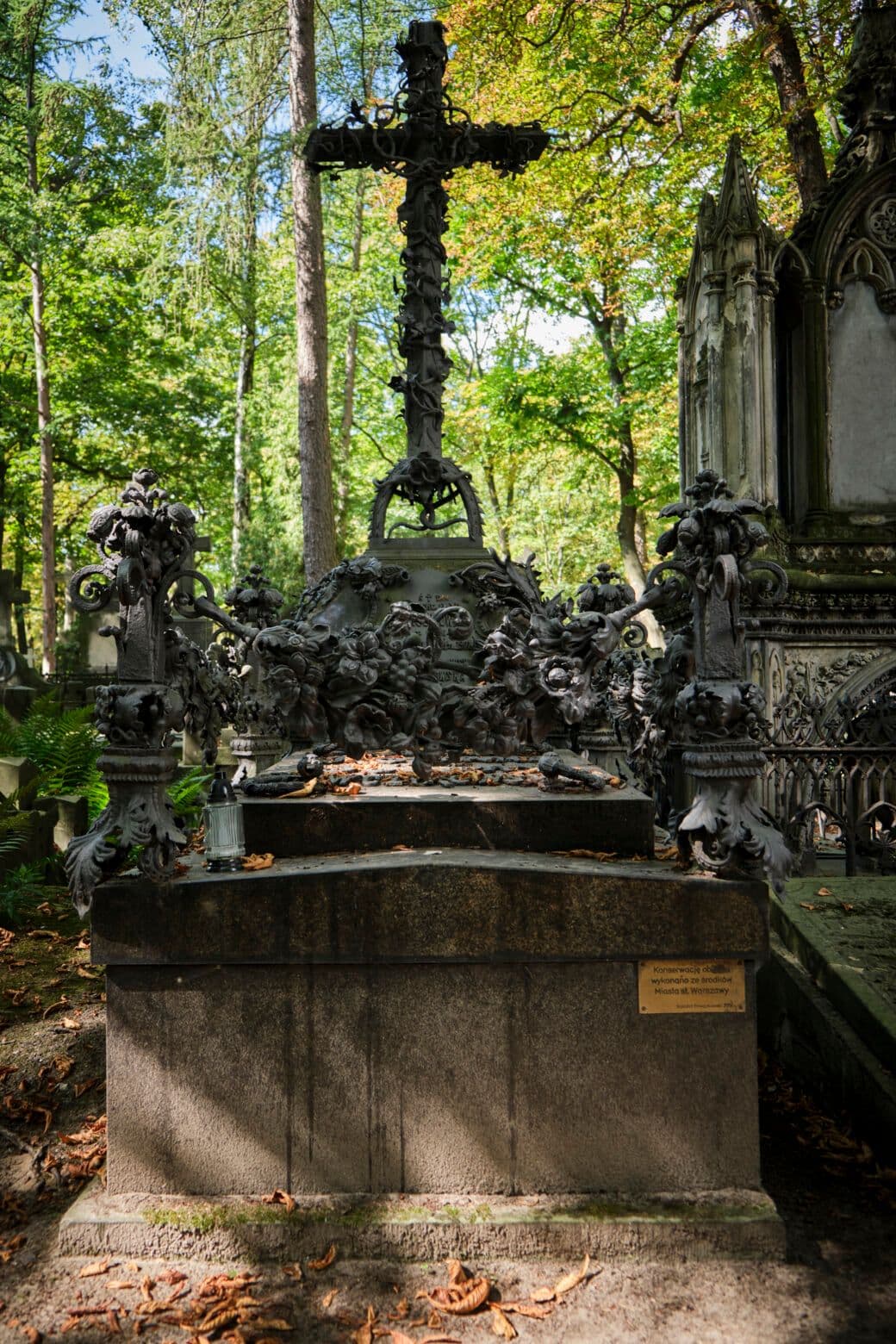

The Iron Florist (1849-1901)
"The boys straighten nails at the shoemaker's, and that's where the tram stops (then off it goes with a ding-ding)" is something you might hear after trying to get chummy with someone who is entirely unreceptive to it. While the tram part is widely understood, the nails may be a little harder to make sense of, even though a few years ago Rafał Jabłoński recalled the origins of this saying (https://www.zw.com.pl/artykul/493313.html).
Nails used to be made by hand and were extremely expensive, so they were repaired. Who else would do that but boys waiting to be promoted to journeymen? Not necessarily in the Guild of Locksmiths, Gunmakers, Spur-makers and Nail-makers. It was in this guild, in 1868, that Roman Szewczykowski was promoted to journeyman—in other words, he was no longer a boy running errands. In keeping with the fashionable currents of Positivism, he decided to serve his country through hard work, and extended the prescribed four-year journey abroad by another four years. But anyone who thinks this was simply an extension of a carefree period of learning would be mistaken. Journeymen worked very hard in those days.
In „Okruchy brązu" ("Fragments of Bronze"), Tadeusz Łopieński even explains the strict law that forbade them to leave the bachelor state: they had to sleep at their place of work. Perhaps they did not complain too much about this, as the working day began at five in the morning and ended at nine in the evening. At least in summer, and from Tuesday to Friday. In winter, work began at six, and every Monday at noon. On Saturdays, it ended at four. This did, however, allow them to become very close to their master and fellow workers.
After such a long journeyman's journey and work in Germany, France, Italy and Montenegro, Szewczykowski had made connections that he would draw on throughout his life. He collected works of art, lectured, and even brought a locksmith from Bavaria to teach journeymen alongside him. When a monument to Adam Mickiewicz was erected in Warsaw at the end of the century, the floral balustrade decorations were commissioned from Szewczykowski, who had an exceptional talent for reproducing flora and was known for this very reason as the Iron Florist. That same year, he was elected elder of the Guild of Locksmiths. He opened a workshop on Wolska Street and married a woman who shared his interests. Joanna supported her husband when he helped establish the Museum of Crafts and diligently catalogued its collections. To this day, works of art are sometimes credited as „za katalogiem Szewczykowskiej" ("according to Szewczykowska's catalogue"). When she was widowed, she continued her husband's work and safeguarded his legacy. She founded a school to train young craftspeople (previously, lessons had been held in the workshop and at the Museum). In the notarial deed, written in Russian, the Polish name—Muzeum Narodowe (National Museum)—appeared in parentheses. Szewczykowski's collection was to go there (and did!) once the Museum was finally established (Ryszard Bobrow, „Początki kolekcji sztuki dekoracyjnej w Muzeum Narodowym w Warszawie" ("The Beginnings of the Decorative Arts Collection at the National Museum in Warsaw") - http://muzeumpamieci.umk.pl/?p=3009).
The workshop at 46 Wolska Street produced true gems, but unfortunately most have not survived. Some were lost during successive bombardments and uprisings; the rest were destroyed by the madness of the claim that „ornament to zbrodnia" ("ornament is a crime"), when decorations miraculously preserved were simply carted off for scrap. Quite a few can be seen in Warsaw's cemeteries: Powązki, the Evangelical-Augsburg Cemetery and the Evangelical Reformed Cemetery are small galleries of artistic ironwork.
Anyone wishing to follow the trail of works from the Wolska Street workshop can turn to Małgorzata Białostocka's fascinating article „Żeliwne dekoracje w twórczości Romana Szewczykowskiego" ("Cast-Iron Decorations in the Work of Roman Szewczykowski") („Ochrona Zabytków" 2006. 4). Anyone curious to see what devoted pupils he had should visit Powązki and look at the Szewczykowski family tombstone they made, restored in 2004 by Wanda Sienicka. Anyone wishing to see the tribute paid to the Elder of the Guild of Locksmiths should go to St Martin's Church on Piwna Street and find the plaque decorated by other master craftsmen. And anyone who enjoys puzzling over meanings might consider why four openwork gates have survived in public spaces, visible to every passer-by. One adorns the entrance to the Matejko House. It was presented in 1904 by the Assembly of Locksmiths in Warsaw to mark the House being taken over by the National Museum in Kraków. The second is a gate found on the left bank of the Vistula, now serving as the entrance to the Home Army Praga District Park on Grochowska Street. The third is the church gate in Radzyń Podlaski, and the fourth leads to the Evangelical Reformed Cemetery at the junction of Żytnia and Młynarska Streets. Habent sua fata monumenta… and works of art, after all, are monuments too—only to human creativity.