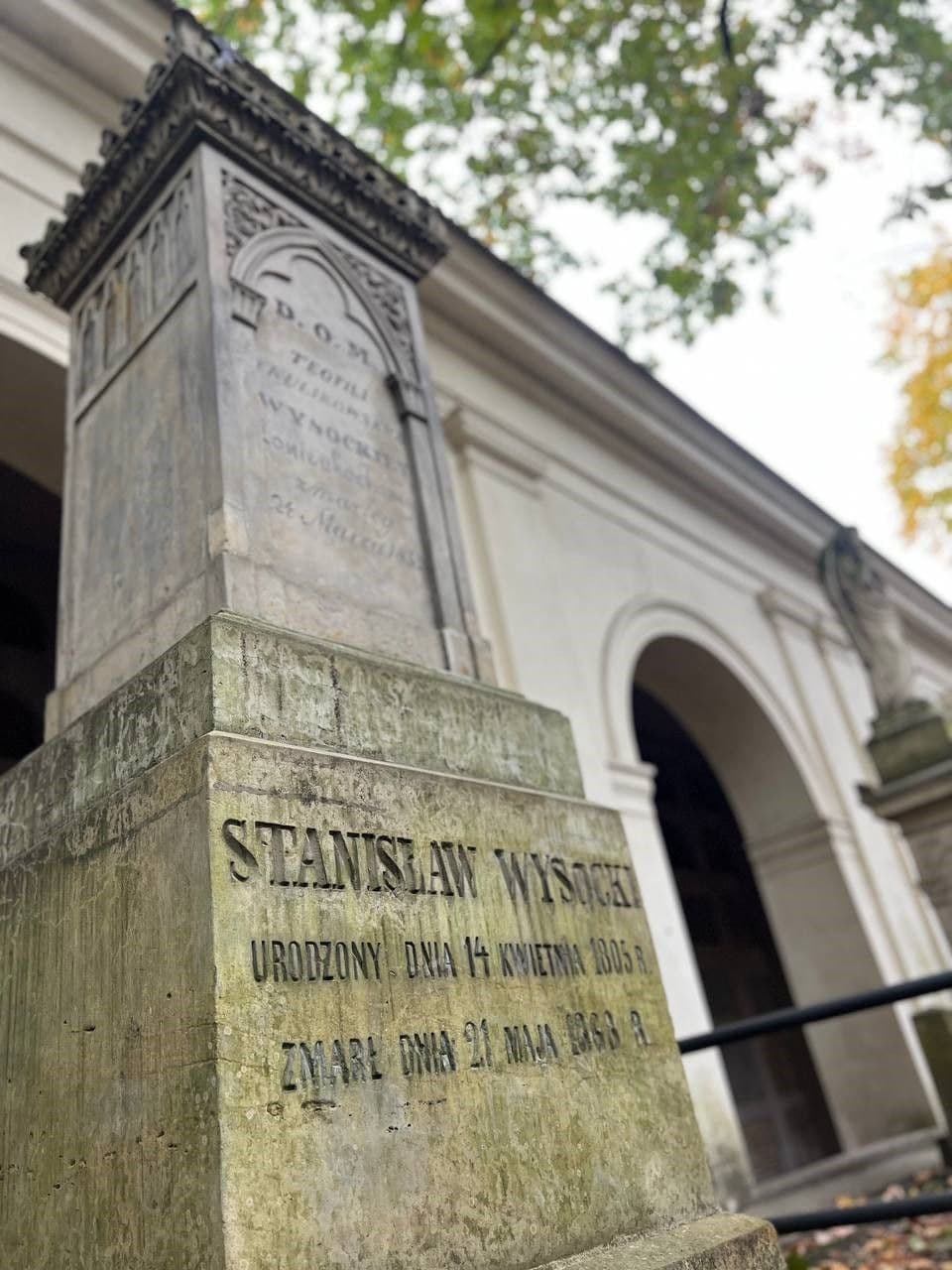

STANISŁAW WYSOCKI (1805-1868; PK 1-22-23), engineer and pioneer of Polish railways. He designed the Warsaw–Vienna Railway. It was the first railway line in the lands of the Kingdom of Poland and, at the same time, the longest railway line being built in Europe at the time. After completing his schooling in Kraków, 18-year-old Wysocki came to Warsaw to continue his education. He became an apprentice at the Government Commission for Internal Affairs and the Police and began studying mathematics at the University of Warsaw. He furthered his education at the School of Civil Engineering for Roads and Bridges and at the Preparatory School for the Polytechnic Institute.
After receiving his engineering diploma in 1829, he began working at the Bank of Poland, which was involved, among other things, in financing road construction. During the November Uprising, he served as a lieutenant in the National Guard, after which he returned to work at the Bank of Poland. While working at the bank, he began developing the technical design and route plan for the Warsaw–Vienna Railway in 1835. Work on the project began in 1838, and Wysocki was one of its principal designers. Along with the merchant and industrialist Piotr Steinkeller, he was one of those who, despite opposition from the tsarist authorities, who wanted the new railway to be horse-drawn, succeeded in pushing through the construction of a steam railway. In 1840, he became chief engineer of the railway's construction. One of his main duties was to prepare annual reports on railway operations in the Kingdom of Poland, examine the volume of freight and passenger traffic, analyze the circumstances and causes of accidents, and assess the technical condition of locomotives and carriages. He was one of the creators of Polish railway terminology. Despite problems with construction and its financing, as well as changes in ownership, Wysocki remained the project's chief engineer throughout. After the railway opened, he became head of the technical department of the Warsaw–Vienna Railway. In 1857, he became an inspector of railways in the Kingdom of Poland. After retiring, he became an adviser to the Warsaw–Terespol Railway.