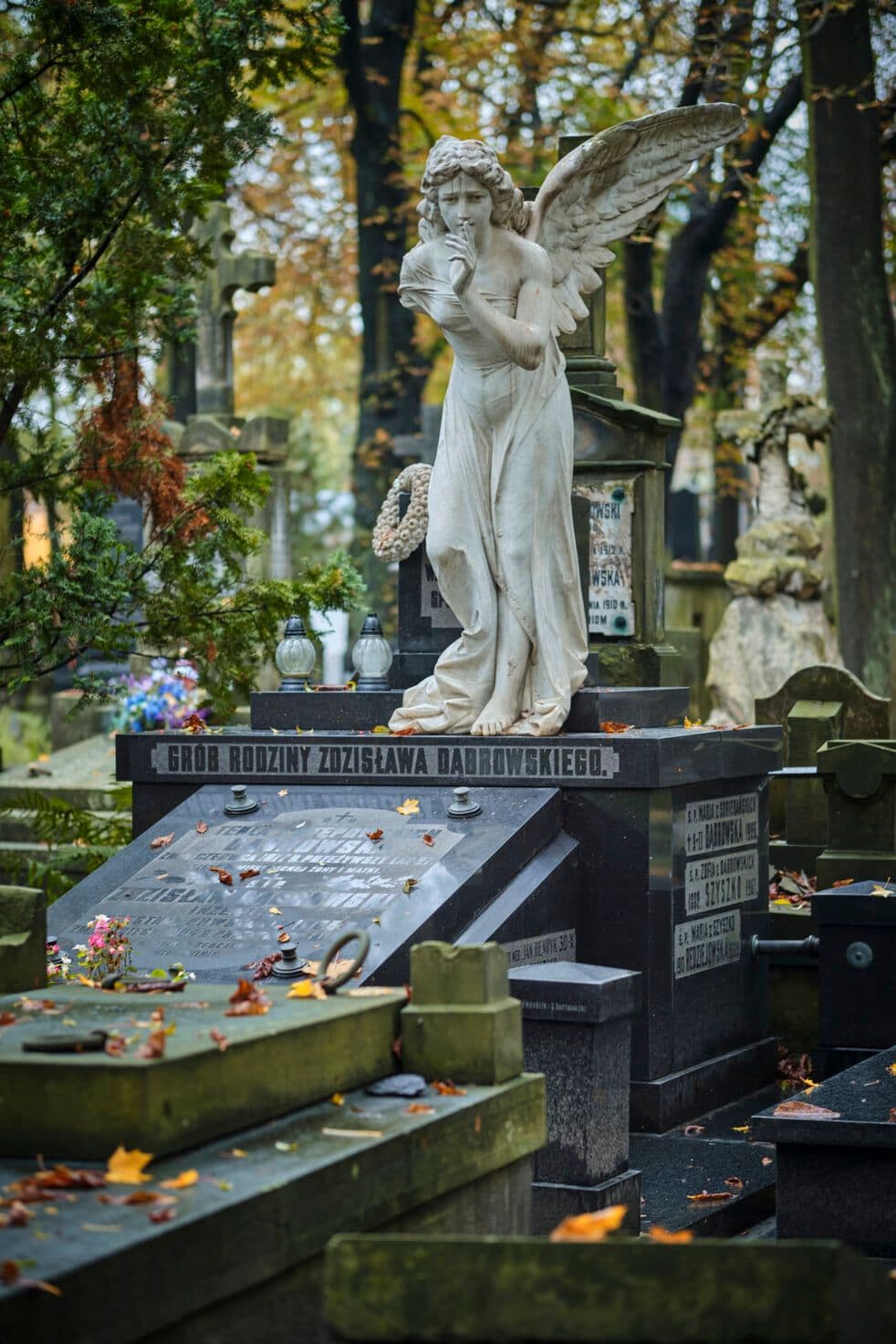

The grave of Zdzisław Dąbrowski's family
"They cried that we were deranged,
not believing us when we said that to want is to be able.
We shed our blood alone,
and our dear commander was with us"
These words of the First Brigade are not an outburst of hysteria by oversensitive young men, but a testament to the views held by the majority of their parents. The very same people who, in their youth, took part in the January Uprising and lived with its consequences—for Poland and their own families. The best-known example is Marshal Piłsudski's family, although at least his mother supported his pursuit of armed struggle, which was generally not the case. His father—a January insurgent—opposed such solutions. Positivist literature did not emerge out of nowhere, any more than the characters portrayed in it. Wokulski with his shop and Połaniecki with his sugar refinery were no exceptions; they had real-life counterparts. It should be added that most advocates of work at the grassroots and organic work were former January insurgents or deportees who had been captured before the uprising.
Their stories continue to inspire people to this day, including writers such as Ida Żmiejewska, author of the crime trilogy Warszawianka. It would be fascinating, however, to see a publication containing as complete a list as possible of their names and describing what these people achieved after the January Uprising: the strength of spirit they retained despite such difficult experiences; their return from prosperous countries where they had found wealth, peace and careers; and the way they brought renown to the Polish name in distant lands, including in the heart of Russia, Prussia and Austria. It would also describe their hard work, thanks to which the industry of the Kingdom of Poland developed 2.5 times faster than that of the entire Empire, rapidly conquering Russian markets. The imperial government therefore began imposing restrictions, which many called "Moscow's war on Łódź"—although, of course, it was not Łódź alone that was at issue; it was simply an exclusively industrial city and could therefore serve as a symbol (Józef Buszko, Wielka Historia Polski, Od niewoli do niepodległości 1864–1918).
One of these people was Zdzisław Hipolit Dąbrowski, son of Ignacy Henryk Dąbrowski of the Ogończyk coat of arms, director of the Department of the Government Commission of Revenue and Treasury, and his wife Zofia Rozalia Flint, whom he married at the Evangelical Reformed Church in Warsaw. Baptized at the Church of St. Charles Borromeo on Chłodna Street, Zdzisław was sent to the provincial gymnasium and began studying law in 1862. He abandoned his studies and took up arms. After the uprising's defeat, during which he was wounded, he hid at manor houses. Fortunately, in 1864 he managed to escape to Gdańsk and from there to Ghent. There he decided to study engineering, becoming an engineer specializing in chemistry and technology. He moved to Paris, where, naturally, he took part in the Franco-Prussian War, since, as we know, our enemies' enemies often become our friends, or at least our allies. Let us quote the Polish Biographical Dictionary, published in 1939–46: "Together with his fellow worker Ferdynand Doliński, he set about installing electric lighting in the forts surrounding Paris. Dąbrowski and Doliński became artillery officers and lit up Paris at night."
Then came Switzerland and an expedition to Mont Blanc. Kraków, Brody and Starachowice, where he realized that metallurgy was not his calling. In 1875 he was back in Warsaw, where he married Tekla née Stępowska at the Capuchin church on Miodowa Street. That same year, his son, also named Zdzisław, was born. He himself became involved in the development of the sugar industry and was one of the founders of Przegląd Techniczny. He considered writing for it a national duty and encouraged young people to do the same; he had an excellent rapport with them. He established a meteorological station at the Museum of Agriculture and Industry and chaired the sugar section of the Warsaw Branch of the Society for the Promotion of Industry and Trade. He went to Bohemia to further his education. In 1877, tragedy struck: his wife died. Four years later, also at the Capuchin church, he married Maria Sobierańska, with whom he would have a daughter, Zofia. Later came Kyiv, work in the sugar industry and collaboration with Poles living there who shared a similar past. Hard work took its toll on his health. He died in Kyiv in February 1904. His body was brought back to Poland and buried in the grave of his first wife. Other family members also found their final resting place there. For his son alone, this is a symbolic grave. An engineer like his father, he was a lieutenant in the 5th Polish Rifle Division, arrested by the Bolsheviks and executed in Krasnoyarsk prison in 1920.
The tomb has a sloping slab resting against a tall black base with a rectangular footprint, topped by a white marble statue of an angel. The family commissioned it in Italy. The artist left neither a signature on the designs nor an invoice for the sculpture. He gave the figure a woman's shape and dressed her rather scantily, which naturally prompted comments that such a depiction was inappropriate for a cemetery. One interesting detail is the finger on the angel's lips. Such a gesture always signifies silence, which is called for beside every coffin. May we always remember that.