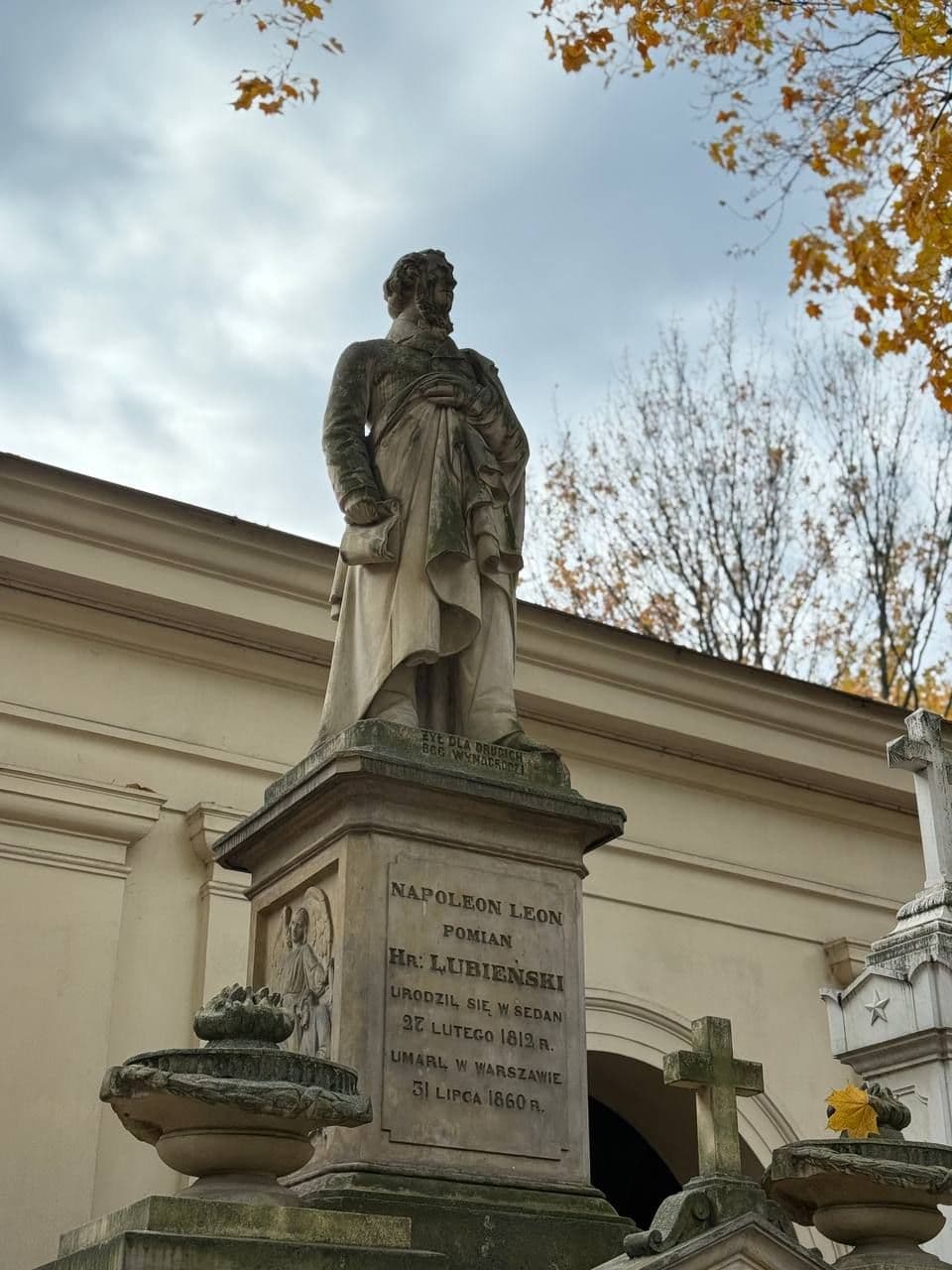

Plot beneath the catacombs, row 1, graves 54 and 55
A count, an emperor's Chevau-léger and an entrepreneur. He was born in 1784 in Szczytniki near Kalisz. He came from a wealthy aristocratic family; his father, Feliks, became Minister of Justice of the Duchy of Warsaw. His career was planned for him from birth. At the age of 6, he was enrolled as a companion in the National Cavalry, and two years later he was promoted to ensign. It is therefore no surprise that he attained the rank of general at the age of 22. He was a member of the Society of Friends of the Fatherland, an elite association whose members were young Polish aristocrats.
After the French army entered Poland, he remained with the other members of the Society of Friends of the Fatherland and was appointed deputy commander of Emperor Napoleon's honour guard, made up mainly of young aristocrats, many of whom joined the newly formed regiment of Chevau-légers of the Imperial Guard. Łubieński became a squadron commander in this regiment. He was also one of the first Poles to receive the French Legion of Honour.
He took part with his squadron in the second charge at Somosierra, coming to the aid of the few participants in the first attack who had reached the top of the pass. During the 1809 campaign, he also took part in major battles against the Austrians at Essling and Wagram, where he distinguished himself through exceptional courage and outstanding leadership. In 1811, he became commander of the 8th Regiment of Chevau-légers-Lancers. At the head of this unit, he took part in the 1812 campaign in Russia. He fought on the Berezina and, in 1813, at Dresden, Culm, Leipzig and Hanau, before leaving the army in January 1814.
In the Kingdom of Poland, he initially served in the army, but, disillusioned with the rules in force there and at odds with Grand Duke Constantine, he left in 1816 and began to focus on economic affairs. He was one of the founders and directors of the Land Credit Society, whose aim was to support Polish landowners by providing loans. Together with his brothers, he founded the Łubieński Brothers and Company trading house and co-founded the Bank of Poland, which was intended to restore the Kingdom of Poland's finances.
This business activity was interrupted by the outbreak of the November Uprising. Tomasz Łubieński returned to the army, albeit reluctantly. During the Battle of Olszynka Grochowska, he commanded the II Cavalry Corps. He belonged to a group of officers who saw no point in continuing the fight. After the uprising's defeat, he was forced to spend two years in Russia. He obtained a pardon from Tsar Nicholas. After returning to Poland, he once again became involved in business. He became director of the construction of the Warsaw–Vienna Railway. He was president of the Merchants' Association and a member of the Agricultural Society and the Society for Charitable Works. He enjoyed the favour of Viceroy Paskevich.
Even before the outbreak of the uprising, he was one of the founders and shareholders of the Linen Products Factory, one of the most modern establishments of its kind in Europe. It was established on the land at Ruda Guzowska belonging to the Łubieński family (now Żyrardów).