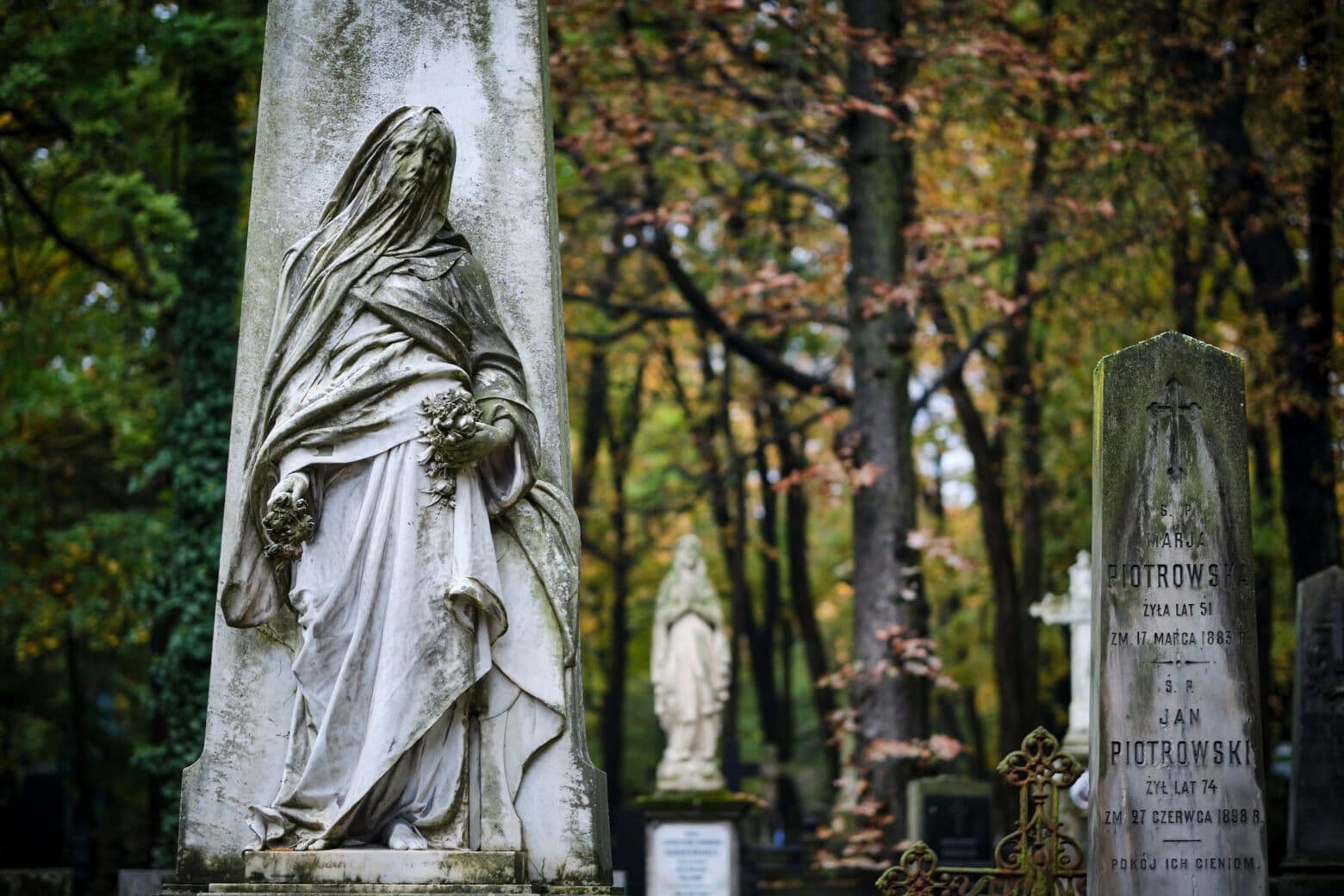

Tomb of Wilhelmina Jakubowska
Many people see the mermaid sculpture on Karowa Street almost every day. Unfortunately, passers-by are not always interested in the artist who created the work they continually pass by. It was Jan Woydyga (1857 – after 1938), an exceptionally hardworking and resourceful man who, after many years of study in Kraków with Guyski, in Warsaw with Molatyński, and in Paris with Cyprian Godebski, returned to his hometown. Fearing there would be few commissions, and despite his immense talent, he set up a workshop for stucco work and sculptural ornament.
The turn of the century was a favorable time for him. To this day, stucco ornaments around ceiling panels can be seen in a few of the townhouses preserved in Warsaw. He later established his own sculpture studio and, as Maria Irena Kwiatkowska, one of the foremost specialists in 19th-century Warsaw sculpture, notes, worked continuously, decorating churches and public buildings. He also received government commissions, such as a bust of Sokrates Starynkiewicz, as well as civic commissions, such as a bust of Arkadiusz Andriejewicz Tołoczanow (d. 1897). Tołoczanow was a tsarist official who came to Warsaw in connection with the enfranchisement of the peasants. He became president of the Land Credit Society and, as one of the few Russian officials, earned the public's sympathy and respect. He was a bibliophile and corresponded with Boudain de Courtenay. In his will, he bequeathed his entire vast and valuable library to the University of Warsaw. It was therefore decided to honor him by decorating the University of Warsaw Library (BUW) with his likeness.
Woydyga also worked in cemeteries; several of his works can be found at Powązki and at both Evangelical cemeteries. The tomb of Wilhelmina, in which he used the weeping-woman motif typical of the period, follows a design first used by Syrewicz for the Herman family tomb. Later monuments depicting a woman dressed in an antique-style robe were all compared with this original—even those made by Syrewicz himself. Woydyga's sculpture has been criticized for its excessive drapery, said to cling rather than flow gently, making the whole work seem heavy. Perhaps it is worth looking at it again, without making comparisons? Perhaps that will lead to different conclusions. Perhaps someone will also uncover new evidence explaining why Woydyga disappeared from public life after 1927, and why even the exact date of his death remains uncertain.