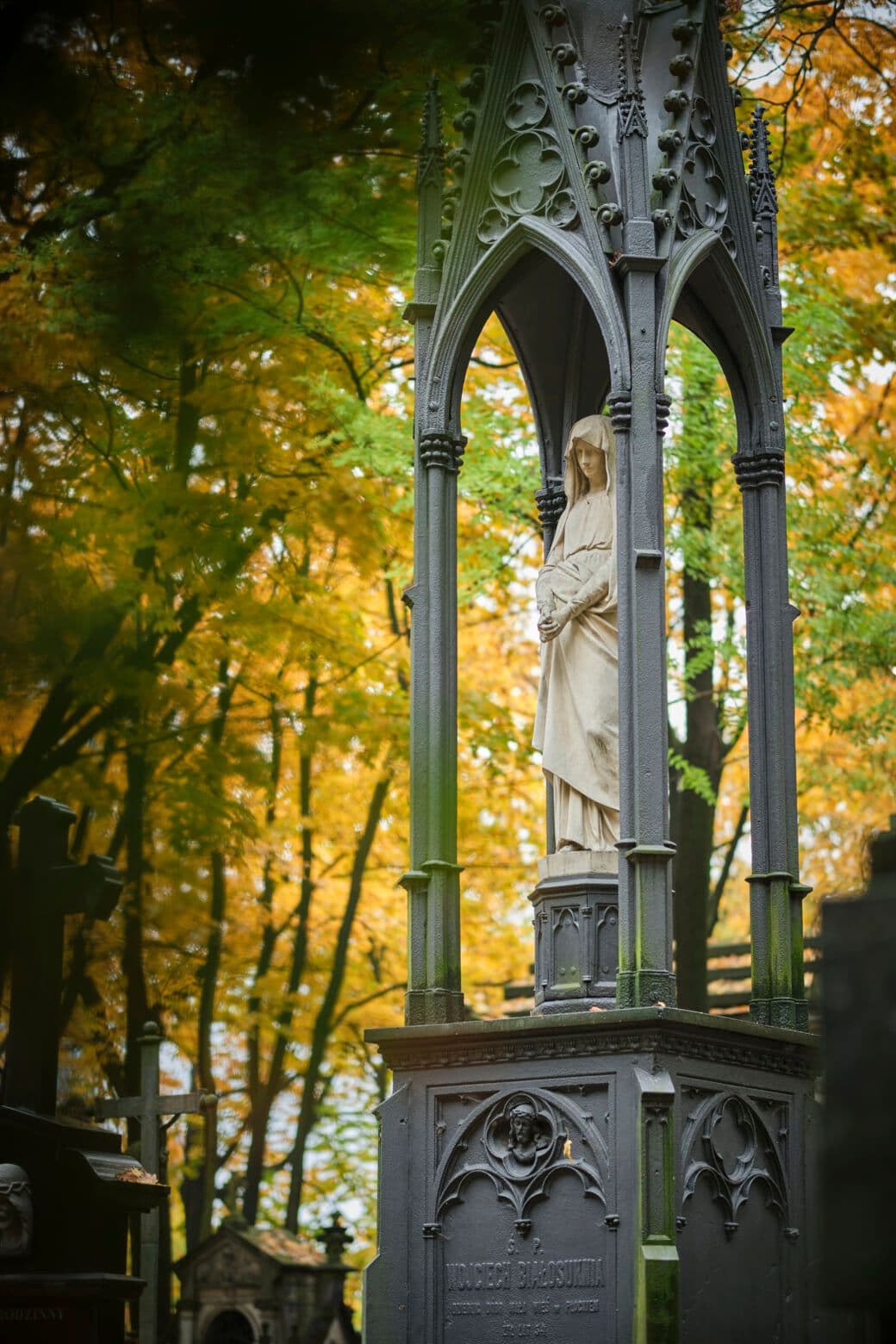

A cast-iron tower for a landowner
The Białosuknia family tomb is an impressive cast-iron structure measuring as much as 7.5 metres in height, topped with a 1.5-metre figure of the Virgin Mary. In the 19th century, cast iron dazzled both builders and artists with the possibilities it offered. It was used to create building frames as well as works of art, such as this tomb located in plot 22.
The Białosuknia family name is recorded as far back as the 15th century, when the family is said to have received the estate of Białusuknia in the Łomża region. The family evidently grew in size, as people with this surname can be found both around Tykocin and near Grajewo. However, we do not know which branch the "Powązki" members of the family came from.
The tomb was built for Wojciech Białosuknia, who died on 22 November 1884. As we learn from the inscription on the tomb, Wojciech Białosuknia owned a village called Nowa Wieś, near Płock.
The village had previously belonged, among others, to the Nakwaski family. Anna Nakwaska, a famous diarist, educator and writer, established an English-style park in the village, with an extensive water system featuring five canals, specimens of foreign trees, numerous statues, garden pavilions, a Swiss-style cottage and an orangery beside a brick manor house with a chapel. Sadly, the manor house burned down in 1915 during the First World War, which ravaged the surrounding area.
In the second half of the 19th century, Wojciech Białosuknia owned the Nowa Wieś estate. This fact is also recorded on his tomb. He seems to have been an energetic estate manager, as we know, among other things, that he arranged for the exchange and consolidation of local peasants' land. Until then, they had owned small, scattered plots. The fact that his descendants financed such an impressive tomb also testifies to the family's wealth.
Witold Białosuknia, a biologist murdered in a German concentration camp in 1945, is buried in the same tomb. He began his career as a biologist in the region where his family lived. In 1899, an agricultural experimental station was established in Chojnów by Stanisław Chechłowski. Its aim was to develop cultivation methods and breed seed varieties that would produce the best possible yields. One of its employees in his youth was Witold Białosuknia, who in 1906 published papers on the physiology of oat and rye varieties bred at the Chojnów station.
Cast iron, used for a significant part of the tomb, was widely employed in art and architecture, in the manufacture of everyday objects, and even in jewellery. This was thanks to the combination of two seemingly contradictory qualities: strength and the ability to achieve highly intricate effects. At the Old Powązki Cemetery, we can find quite a number of gravestones that make use of this material in various ways. The tomb also bears the following inscription: "I lived because You willed it, I die because You command it, save me because You can."