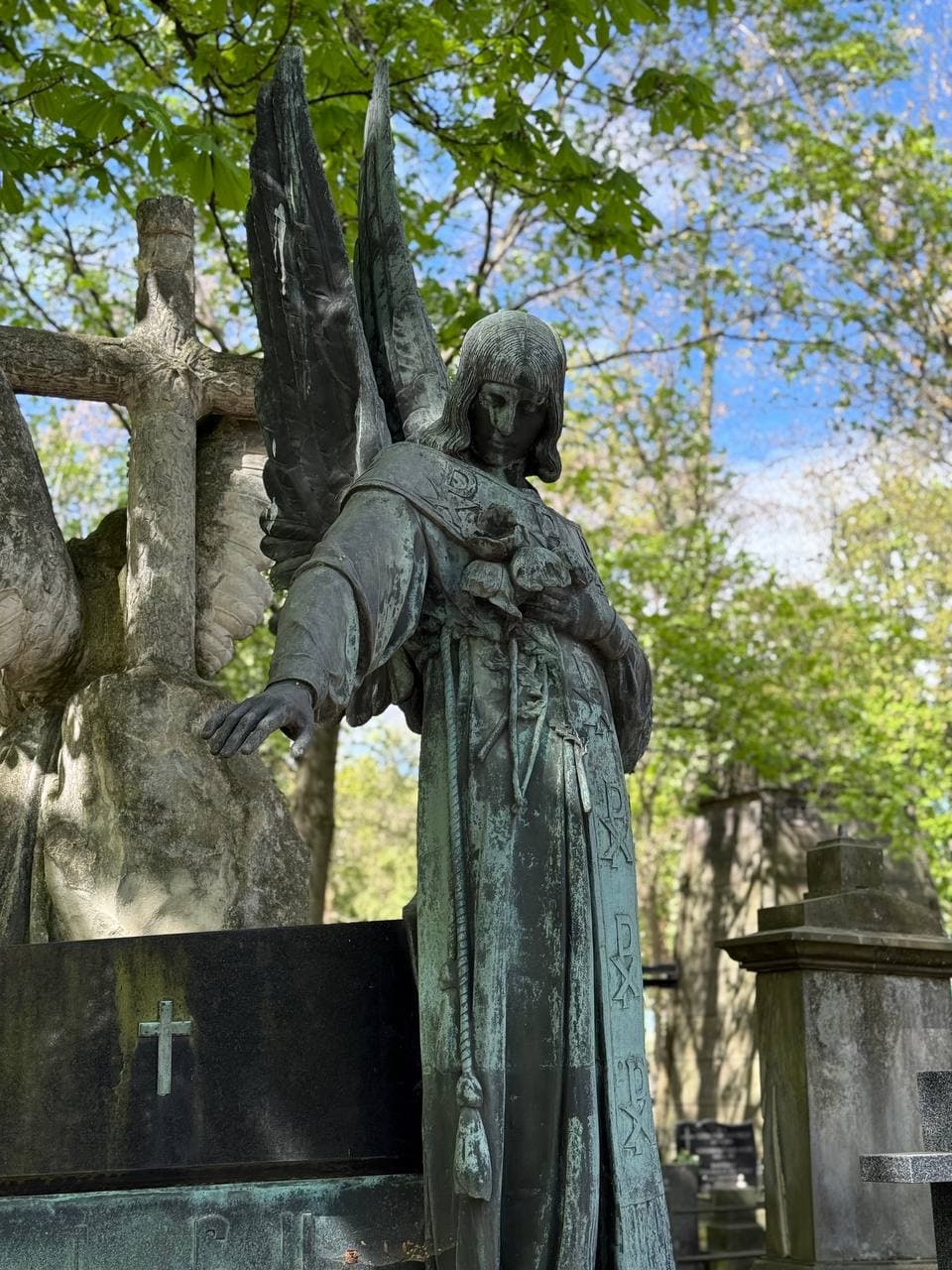

Among the plant motifs found on gravestones, the poppy holds a special place. Although it is not as immediately recognizable as the rose or ivy, its meaning has a long and well-established tradition dating back to antiquity.
Since ancient times, the poppy has been associated with sleep. In the Mediterranean world, its calming and sleep-inducing properties were well known, which is why it became an attribute of Hypnos, the god of sleep; Morpheus, the god of dreams; and Thanatos, the personification of death. It also appears in the myth of Demeter, overcome with grief after losing her daughter—sleep is what brings her temporary solace. In this way, the poppy came to symbolize a state suspended between sleep and awakening.
Sleep as an image of death
In funerary art, this meaning takes on particular depth. The poppy represents sleep that is not an end, but a promise of awakening. Death is depicted not as a definitive end, but as a passage—"sleep before awakening." This is one of the oldest and most enduring ideas in European culture.
This symbol was also readily understood in Polish culture. For centuries, poppies and poppy preparations were used as calming and sleep-inducing remedies, including in household practices. As a result, their symbolism was intuitively understood by both the elite and the common people.
Christian meanings
In the Christian tradition, the poppy acquired additional interpretations. The flower's red color is sometimes read as a symbol of Christ's blood and Passion, but also—and especially significant in the context of a gravestone—of the Resurrection. The sleep of death leads here to new life, and the poppy becomes a sign of hope for renewal and eternal life.
The poppy and remembrance of sacrifice
In the 20th century, the symbolism of the poppy was strengthened by the experience of war. Thanks to John McCrae's poem In Flanders Fields and Feliks Konarski's song Red Poppies on Monte Cassino, the flower also came to represent remembrance of the fallen and the sacrifice of life. This meaning is particularly powerful in the Polish context—the poppy brings together the themes of sleep, death, and collective memory.
A simple symbol with deep meaning
On gravestones, the poppy may appear as a single flower, a decorative element, or part of a larger floral composition. Its form remains modest, but its meaning is layered: from sleep and solace, through death understood as a passage, to the hope of renewal and remembrance of those who have passed away.
It is one of those symbols that, although rooted in antiquity, remains understandable to this day.