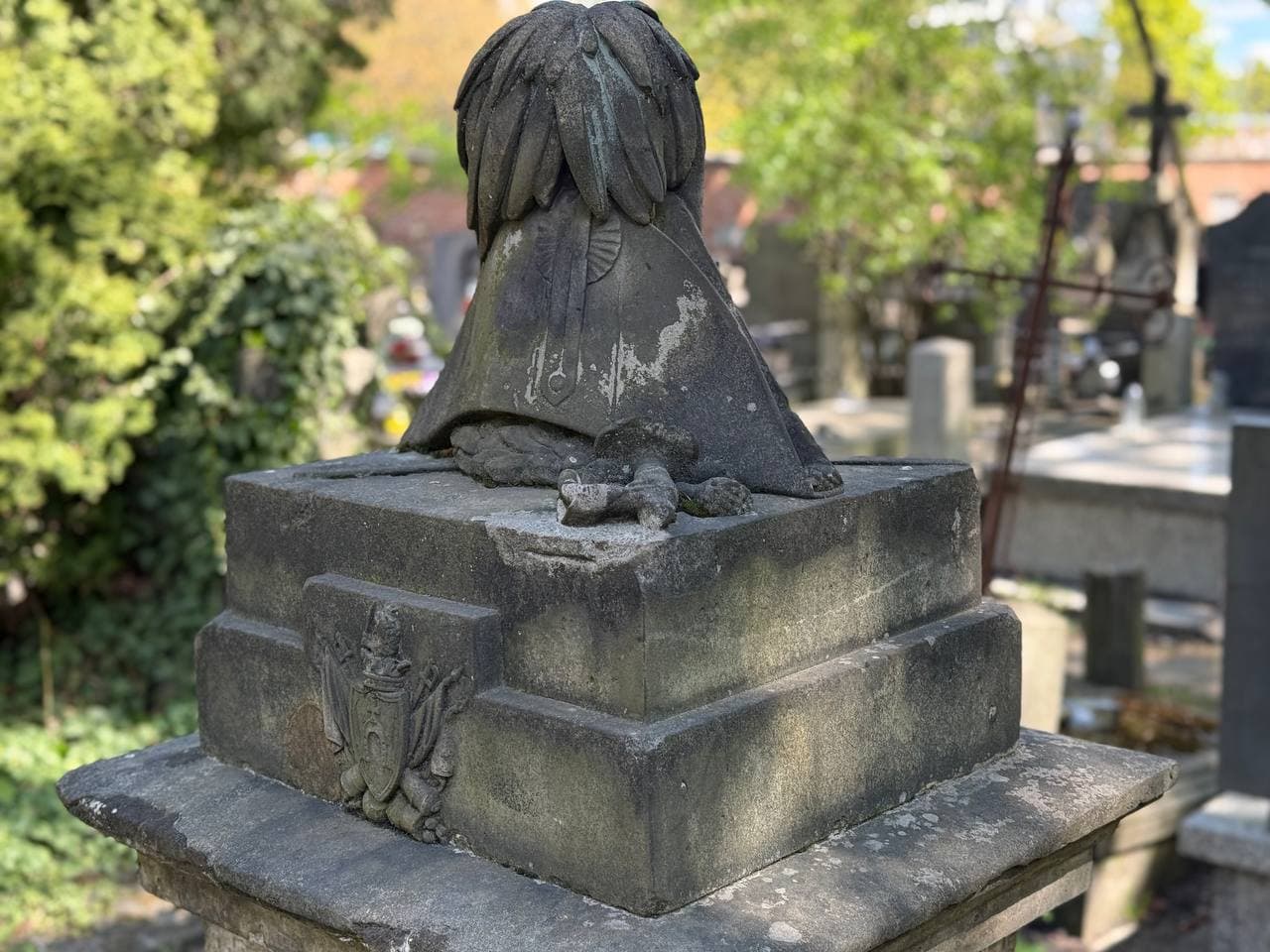

While walking through Old Powązki Cemetery, you may come across tombstones decorated with compositions of weapons, shields, helmets or fragments of armour. This distinctive motif is known as a panoply—a symbol dating back to antiquity which, in funerary art, signifies above all courage, service and remembrance of the deceased's deeds.
The word "panoply" comes from Greek (pan – "all", "whole"; hoplon – "weapon", "armour") and originally meant a warrior's full equipment, especially that of a hoplite. In art, the term refers to a decorative motif composed of elements of weaponry—such as swords, spears, shields, helmets or fragments of armour—arranged in ornamental, often symmetrical compositions.
The motif has appeared in architectural sculpture, painting and decorative arts since the Renaissance, and became especially popular during the Baroque and Neoclassical periods.
Ancient origins
The roots of the panoply reach back to ancient Greece and Rome. In the ancient world, weapons had not only practical but also symbolic significance. After a victory over an enemy, captured weapons were sometimes displayed as trophies—a sign of triumph and glory. In Roman art, the motif was preserved in reliefs and architectural decorations, where displays of weapons commemorated military successes.
Over time, the panoply ceased to be an actual trophy and became a symbolic and decorative motif—a bearer of memories of battle, triumph and military glory.
Panoplies on tombstones
In funerary art, the panoply became more widespread in the modern era, particularly in the 18th and 19th centuries. On tombstones, it serves as an identifying sign: it indicates that the deceased was a soldier or that their life was connected with military service, combat or the defence of their homeland.
At Old Powązki Cemetery, this motif is found primarily on the graves of soldiers and insurgents, as well as in the tombs of families with patriotic traditions.
What does a panoply mean?
The meaning of this motif is multilayered:
Courage and honour – weapons symbolise bravery, readiness to fight and loyalty to one's values. Service and duty – they recall a life devoted to one's homeland or community. Remembrance of deeds – the motif acts as a biographical shorthand, indicating the military nature of the deceased's life. Reflection on transience – in the context of a tombstone, even the most impressive armour cannot protect against death, placing the panoply within the tradition of vanitas. Form and meaning
On tombstones, panoplies take various forms—from stylised compositions inspired by antiquity to arrangements featuring elements of modern weaponry, such as sabres, rifles or fragments of military equipment. Regardless of the details, their message remains clear.
A symbol that speaks of life
The panoply is one of those motifs that refer not directly to death itself, but to the life that came before it. It tells of the deceased's deeds, character and values. On a tombstone, it becomes a sign of remembrance—a reminder that behind the stone form lies a real story of service, struggle and courage.