
The rose is one of the oldest and most multilayered symbols found on tombstones. Its meaning has developed over the centuries—from antiquity to the Christian tradition—which is why it brings together different, complementary meanings.
The most fundamental meaning of the rose is love. In the ancient world, it was an attribute of Aphrodite (Venus), the goddess of love, establishing its symbolism as a feeling that is beautiful yet enduring. On tombstones, the rose expresses the bond between the deceased and the living: a memory that does not fade, and an attachment that transcends the boundary of death.
Flower of life and transience
The rose is also a symbol of the fragility of human life. Its natural cycle—from bud, through bloom, to withering—is readily read as a metaphor for human existence. In funerary art, the way the flower is depicted can be significant: a bud may represent a life cut short, a flower in bloom maturity, and a withered flower serves as a reminder of transience (vanitas).
In this way, the rose brings together two seemingly opposing meanings: the beauty of life and its impermanence.
Christian meanings
Christianity developed this symbolism, giving it a deeper religious dimension. The rose became one of the symbols of the Mother of God (known as Rosa Mystica—Mystical Rose), as well as a sign of perfection and purity.
At the same time, the flower's red color and its thorns came to be associated with the Passion of Christ—with blood, suffering, and sacrifice. In this context, the rose signifies love "to the end," ready to make sacrifices.
For this reason, it also appears as an attribute of certain saints, including St. Elizabeth of Hungary, St. Rita, and St. Thérèse of Lisieux.
The rose and secrecy (sub rosa)
One more meaning of the rose, dating back to antiquity, is less often remembered. The flower was a symbol of discretion and secrecy. According to ancient tradition, anything said "under the rose" (sub rosa) was to remain confidential. In ancient and medieval tradition, the rose therefore signified a conversation held in confidence, which was not to be shared beyond those taking part.
Although this meaning is rarely depicted directly on tombstones, it fits well with the character of a cemetery—a place of silence, contemplation, and personal remembrance.
A multilayered symbol
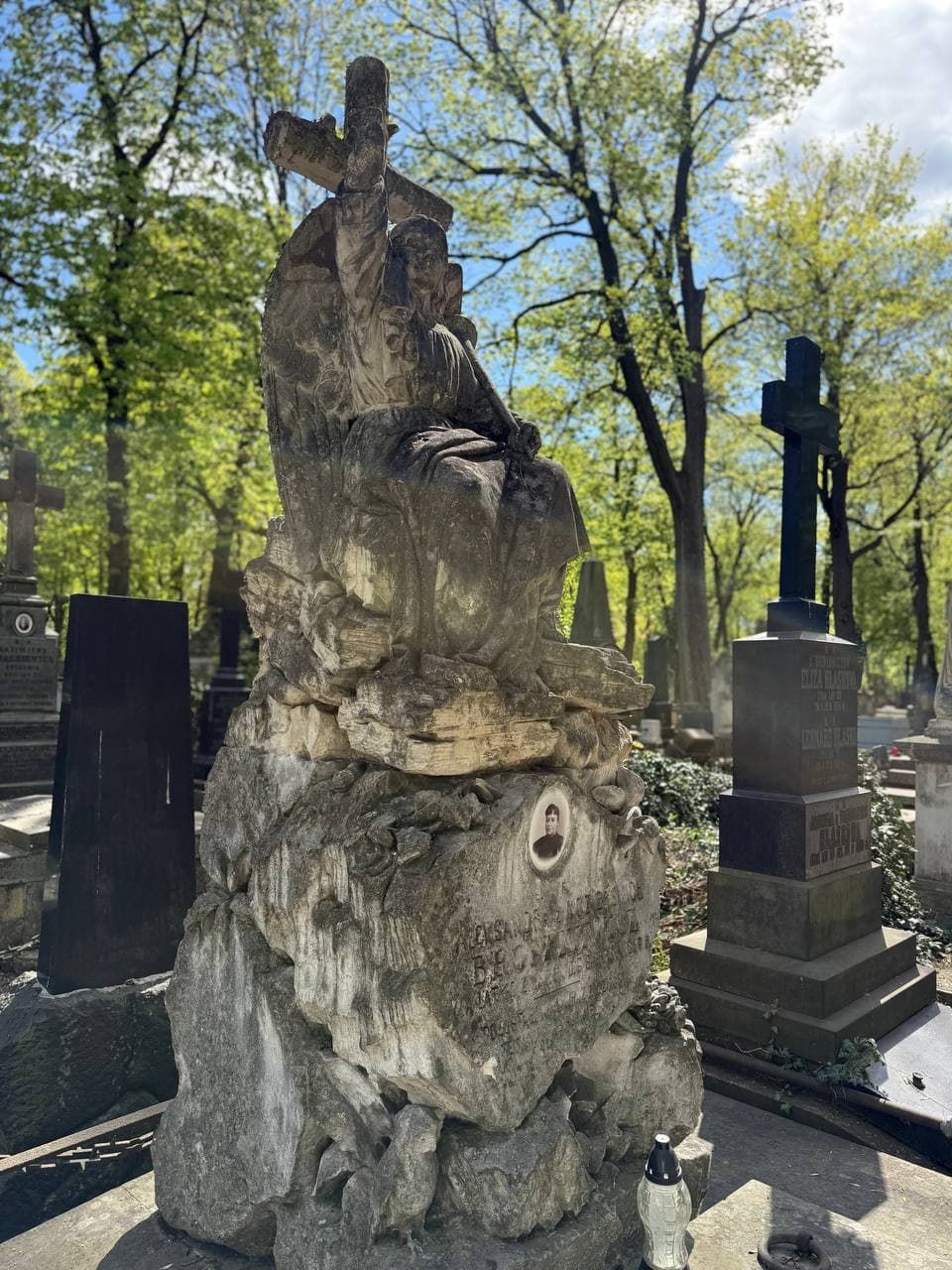
At Old Powązki, the rose appears in many forms—as a single flower, a wreath, or part of a floral decoration. Whatever its form, it remains a symbol rich in meaning: of love and remembrance, the transience of life, and also hope rooted in the Christian tradition.
It is precisely this multiplicity of meanings that has made the rose one of the most important and moving motifs in funerary art for centuries.