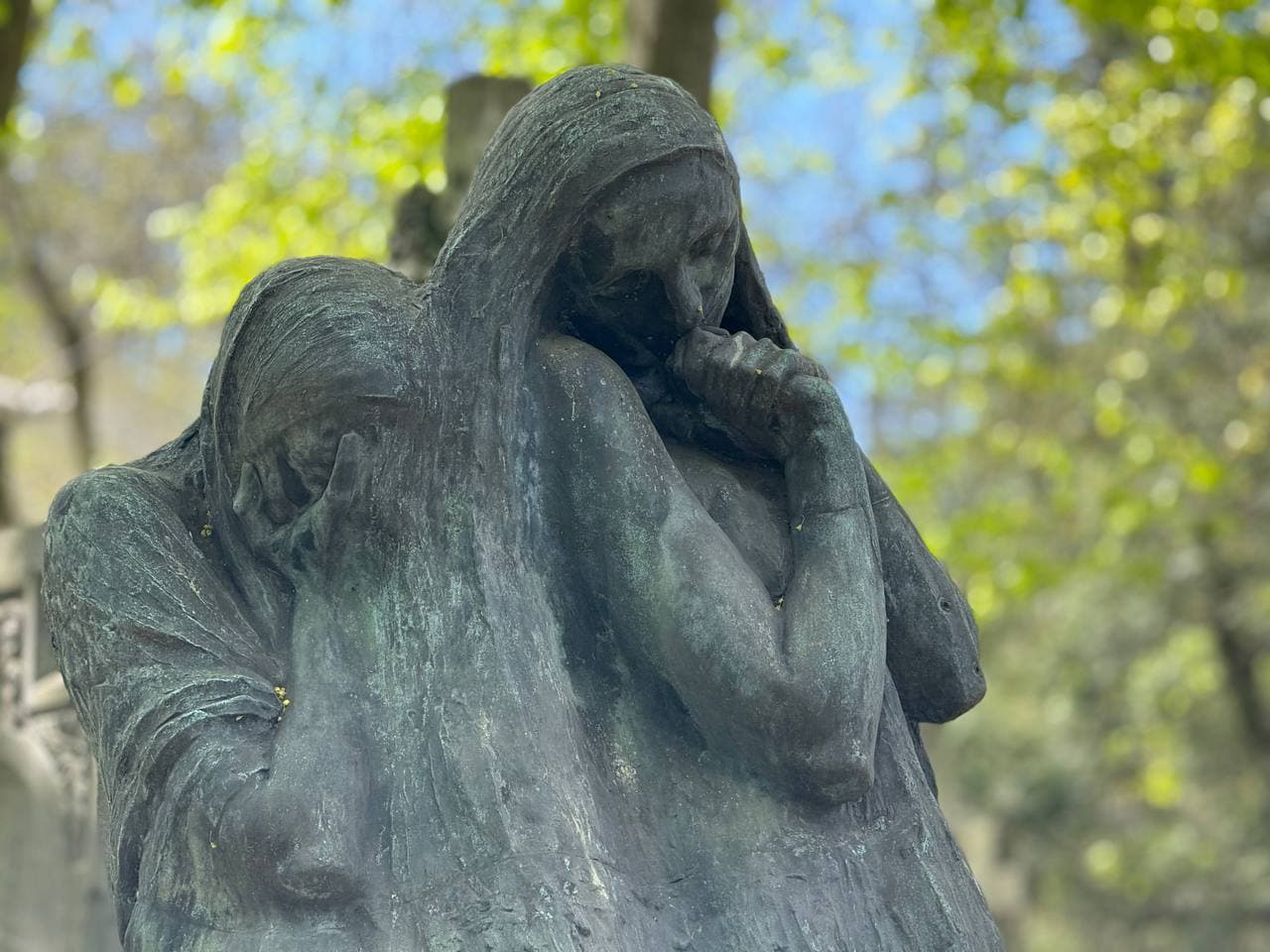

As you walk through Old Powązki Cemetery, it is easy to notice stone and bronze female figures immersed in grief. These are mourning women, commonly also called weepers—among the most moving and distinctive motifs in this necropolis.
They are more than mere decorations on tombs. The mourning woman is a symbolic image of grief transformed into sculptural form—an expression of longing, remembrance and an enduring bond with the deceased. She embodies the feelings of those left behind: sorrow over their loss, but also a love that, according to traditional belief, does not end with death. In this sense, the figure becomes a personification of memory and of the emotional presence of the living at the grave.
How can you recognize them?
Mourning women are most often depicted as seated or standing figures, with their heads bowed, their faces partly covered or their gaze directed towards the ground. They are often shown leaning against a tomb, an urn or a cross. Their gestures are restrained—instead of an impassioned lament, we see solemnity, silence and contemplation. This treatment emphasizes the intimate nature of mourning, understood as an inner experience rather than a public display of emotion.
Where did they come from?
The motif of the mourning woman dates back to antiquity. In Greece and Rome, professional mourners (praeficae) took part in funeral rites, lamenting the deceased through song and gesture. In modern art—especially in the 19th century, when Old Powązki Cemetery was taking shape—artists drew on this ancient model, but gave it a new form. Expressive lament was replaced by quiet reflection. Theatricality gave way to introspection, in keeping with the Romantic, and later more private, experience of death.
Mourning women and offering-bearers—a key distinction
It is worth distinguishing mourning women from so-called offering-bearers (canephores). In ancient Greece, canephores took part in religious processions, carrying baskets or vessels containing sacrificial offerings. They were not associated with mourning. At Powązki, by contrast, depictions of actual mourning women predominate—women immersed in grief, rather than figures taking part in a sacrificial ritual.
The symbolism of gesture and posture
It is not only the motif itself that matters, but also how it is depicted. A covered face or lowered eyes emphasizes the intimacy of grief and the difficulty of expressing loss. Leaning against a tomb, an urn or a cross suggests symbolically "remaining with the deceased" and the connection between the world of the living and the place of rest.
In some works, the mourning woman takes on a more allegorical form—in such cases, she may personify Mourning (Luctus), Sorrow or Memory as universal values that transcend an individual story.
The Christian dimension
In a Christian context, the figure of the mourning woman takes on an additional meaning. Although she expresses the pain of loss, she is not without hope. Her calm, contemplative posture may suggest acceptance of death as a passage rather than an absolute end. She evokes a quiet mood conducive to reflection and prayer.
Why women?
It is no coincidence that mourning is personified by women. In many cultures, they served as guardians of memory and funeral rituals. The motif is also deeply rooted in the ancient tradition—it evokes, among others, the figure of Antigone, who symbolically defended the right to burial and remembrance of the dead.
Models and inspirations at Old Powązki Cemetery
Among the works at Powązki, the creations of outstanding 19th-century sculptors played a particularly important role. One important model was a figure by Paweł Maliński from the monument to Aleksander Janicki (Section 14, Row I), a student of Fryderyk Chopin. This composition became an important model for later funerary works.
The statue of Polonia by Jakub Tatarkiewicz (Section 8, Row I) is also noteworthy. A student of Bertel Thorvaldsen and Paweł Maliński, he was among the artists who significantly shaped the artistic character of Old Powązki Cemetery.