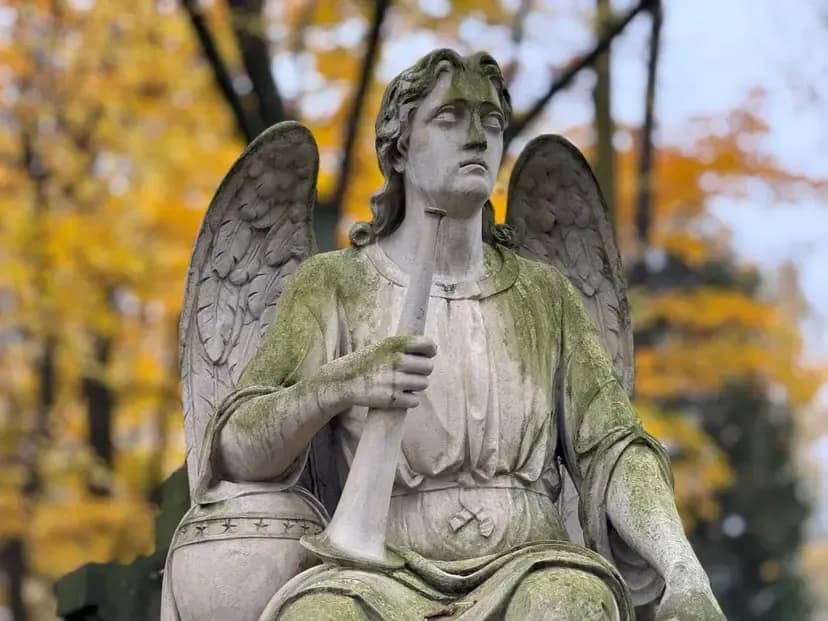
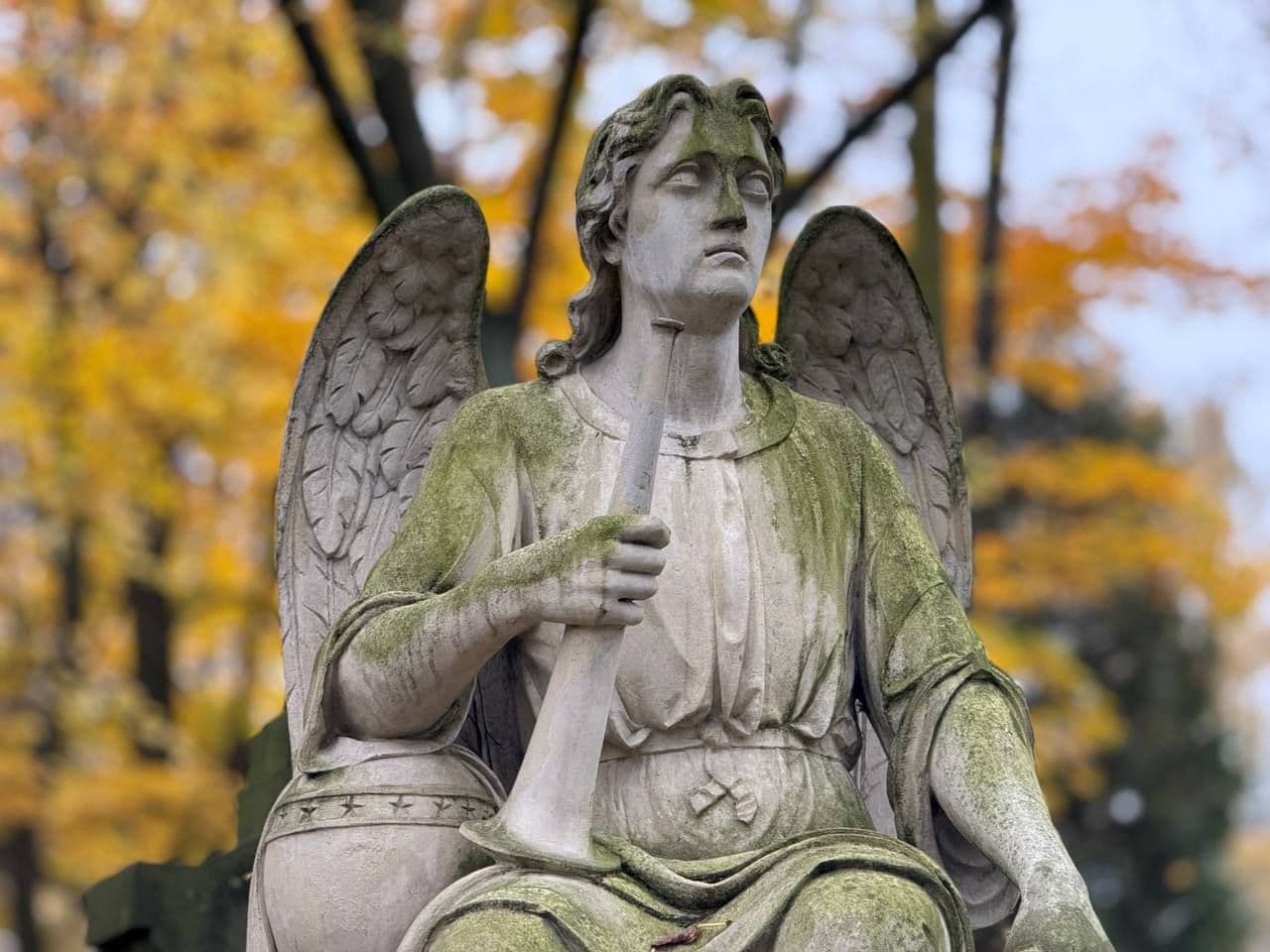
The Stare Powązki Foundation continues to digitize historic monuments at one of Poland's most important cemeteries. Another monument has been preserved as a 3D scan, allowing its form and sculptural details to be examined closely. This time, as part of the ongoing development of the digital Dictionary of Symbols, we explore the meaning of the trumpet – an instrument that in funerary art symbolizes both hope for resurrection and a person's enduring fame.
The photograph shows the historic tomb in its actual form. Thanks to the digitization process, you can also view it in a virtual space using the 3D model available on the Foundation's website.
The trumpet – a symbol with a centuries-old tradition
The symbolism of the trumpet dates back to ancient times. Its loud sound was used to summon assemblies, convey military commands, mark the beginning of ceremonies and announce victories.
The instrument also acquired particular significance in the biblical tradition. In the Old Testament, the sound of the trumpet accompanied God's revelation on Mount Sinai (Ex 19:16–19). Trumpets also play an important role in the story of the conquest of Jericho, whose walls fell after the Israelites marched around the city in a ritual procession (Josh 6).
In both cases, the sound of the instrument marked an event of particular significance and served as a sign of God's power.
The trumpet as a symbol of resurrection and the Last Judgment
In Christian tradition, the trumpet is above all a symbol of the resurrection of the dead and a foretelling of the Last Judgment.
In the Gospel according to St Matthew, Christ foretells that angels will be sent with a loud trumpet call to gather the elect (Mt 24:31). St Paul, in his First Letter to the Corinthians, says that at the sound of the last trumpet, the dead will be raised imperishable (1 Cor 15:52).
This motif became an important element of Christian iconography depicting the Last Judgment. Angels blowing trumpets summon the dead to rise from their graves and appear before Christ the Judge.
The trumpet, then, is not a symbol of death itself, but of the promise of new life.
The symbolism of the instrument is especially elaborate in the Book of Revelation, in which seven angels are given seven trumpets. Their successive blasts herald dramatic events preceding God's ultimate victory (Rev 8–11).
Fama – the trumpet as a symbol of fame and remembrance
However, a trumpet depicted on an old tomb does not always refer to the Christian vision of resurrection.
In the classical tradition, it was also an attribute of Fama, the personification of Fame, most often depicted as a winged female figure. Her role was to proclaim the deeds and achievements of outstanding people.
In funerary art, this image took on particular significance. It served as a reminder that although human life passes, the memory of a person's achievements and accomplishments can endure for generations.
This distinction is particularly important when interpreting Neoclassical and 19th-century tombs. A winged figure with a trumpet does not necessarily represent the Angel of the Resurrection – it may be an allegory of Fame.
Tomb symbolism – a legacy carved in stone
The trumpet is one of those funerary motifs whose meaning extends far beyond decoration.
In the Christian tradition, its sound heralds resurrection and a meeting with God. In the classical tradition, it proclaims the fame and merits of a person whose achievements are to live on in the memory of future generations.
Both meanings share the idea of transcending the boundary of death. The trumpet becomes a symbol of hope, remembrance and endurance – in both religious and secular terms.
Interpreting such images helps us better understand the meaning of old tombs, their artistic form and the values that mattered to generations past.
Digitizing the monuments of Stare Powązki – explore a tomb in 3D
The historic monuments of Stare Powązki are an exceptional testament to history, culture and funerary art. Protecting them means not only preserving their physical fabric, but also documenting their artistic forms and explaining the meanings conveyed by their sculptural decorations.
One of the initiatives undertaken by the Stare Powązki Foundation is creating digital replicas of historic tombs.
3D scanning technology makes it possible to reproduce the form of monuments with precision, including sculptural details that often go unnoticed during an ordinary walk through the cemetery. Digital documentation is also an important resource for preserving knowledge of these monuments for future generations.
As part of the ongoing development of the Dictionary of Symbols, the Foundation is making more monuments available together with explanations of their meaning, combining the protection of cultural heritage with historical education and the promotion of funerary art.
We invite you to view the 3D scan of the tomb featured here and learn about the symbolism of the trumpet on the Stare Powązki Foundation website.
View the 3D scan and discover the symbolism of the trumpet:
Trąba
Trąba jest jednym z najbardziej charakterystycznych symboli chrześcijańskiej sztuki sepulkralnej. Oznacza przede wszystkim zapowiedź Sądu Ostatecznego, zmartwychwstania umarłych i nadejścia życia wiecznego. Ma jednak również znaczenie świeckie – od starożytności była instrumentem służącym do ogłaszania ważnych wydarzeń, zwycięstw i oddawania honorów. W sztuce nagrobnej może więc symbolizować zarówno nadzieję na zbawienie, jak i sławę oraz zasługi zmarłego.
Discover Stare Powązki – virtually and in person
Modern technology makes it possible to discover the remarkable heritage of Stare Powązki from anywhere in the world. Digital models of historic tombs let you examine their decorations in detail, learn what individual symbols mean and appreciate the skill of the sculptors of the past.
However, while the virtual world offers exceptional ways to explore historic monuments, it cannot replace experiencing them in person.
That is why the Stare Powązki Foundation also invites you to explore this historic cemetery in person during free educational sessions led by licensed guides.
It is an opportunity to learn about the people buried here, admire the architecture and funerary art, and understand the rich language of symbols through which generations have told stories of remembrance, the passage of time, hope and human life.
Book a free educational session:
Rezerwacja lekcji z przewodnikiem
na Starych Powązkach
https://edukacja.stare-powazki.pl/pl/rezerwacja
The educational projects of the Stare Powązki Foundation are supported by:
PFR Foundation, ORLEN Foundation, Industrial Development Agency Foundation, Bank Pekao S.A. Foundation, PKP Group Foundation, Budimex S.A., PZU Foundation – Help Is Power – PZU's social responsibility initiative, and PGE Foundation – PGE Energy of Science.